MCQ
The $IUPAC$ name of the compound is
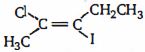
- ✓$trans-2-$ chloro $-3-$ iodo $-2-$ pentene
- B$cis-2-$ chloro $-3-$ iodo $-2-$ pentene
- C$trans -3-$ iodo $-4-$ chloro $-3-$ pentene
- D$cis-3-$ iodo $-4-$ chloro $-3-$ pentene
The parent hydrocarbon contains $5 C$ atom continuous chain with one $C = C$ bond between second and third carbon atom.
Hence, it is named as $2$-pentene.
One $Cl$ and one $I$ are present at second and third carbon atom respectively.
The molecule has trans geometry across $C = C$ bond.
Hence, it is named trans-$2$-chloro-$3$-iodo-$2$-pentene.
Generate a complete, print-ready paper with questions like this in minutes — across 16+ boards, with answer keys.
$(A)$Covalent radius decreases down the group from $\mathrm{C}$ to $\mathrm{Pb}$ in a regular manner.
$(B)$ Electronegativity decreases from $\mathrm{C}$ to $\mathrm{Pb}$ down the group gradually.
$(C)$ Maximum covalence of $\mathrm{C}$ is $4$ whereas other elements can expand their covalence due to presence of $d$ orbitals.
$(D)$ Heavier elements do not form $\mathrm{p} \pi-p \pi$ bonds.
$(E)$ Carbon can exhibit negative oxidation states.
Choose the correct answer from the options given below: