MCQ
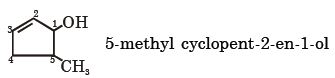
The $IUPAC$ name of the compound
  • A
    $4$ -Methylcyclopent- $1$ -en- $2$ -ol
  • $5$ -Methylcyclopent- $2$ -en- $1$ -ol
  • C
    $2$ -Methylcyclopent- $4$ -en- $1$ -ol
  • D
    $3$ -Methylcyclopent- $1$ -en- $2$ -ol

Answer

Correct option: B.
$5$ -Methylcyclopent- $2$ -en- $1$ -ol
b

Need a full question paper?

Generate a complete, print-ready paper with questions like this in minutes — across 16+ boards, with answer keys.

Start Generating Free

Similar questions

Which of the following molecules has highest dipole moment ?
A reaction is $A + B \to C + D$. Initially we start with equal concentration of $A$ and $B$. At equilibrium we find the moles of $C$ is two times of $A$. What is the equilibrium constant of the reaction
Which element is not present in Nessler's reagent?
Most stable carbocation among following is
The amine which can not prepared by Gabriels phthalmide synthesis method
A compound $H _2 X$ with molar weight of $80 g$ is dissolved in a solvent having density of $0.4 \ g ml ^{-1}$. Assuming no change in volume upon dissolution, the molality of a $3.2$ molar solution is
Select the correct statements for quantum numbers.

$(i)$ Magnetic quantum no. $(m_l )$ gives information about the spatial orientation of orbitals with respect to standard set of co-ordinate axis.

$(ii)$ Electron spin quantum no. is represented by '$s$' and have value' $\frac{1}{2}$ '

$(iii)$ Principal quantum no. $(n)$ determine the size of the orbitals and also to a large extent of the energy of the orbitals.

Suppose following reaction $C$ and $D$ are related as

$CH \equiv CH\xrightarrow[{(excess)}]{{NaN{H_2}/liq.N{H_3}}}A\xrightarrow{{2C{H_3} - I}}B\xrightarrow[{quinolene}]{{{H_2}/Pd - BaS{O_4}}}C$

$C\xrightarrow[{quinolene}]{{{H_2}/Pd - BaS{O_4}}}\xrightarrow[{liq.\,N{H_3}}]{{NaN{H_2}}}D$

Which of the following compound is optically active?
When two mole of an ideal gas $\left( {{C_{p.m.}} = \frac{5}{2}\,R} \right)$ heated from $300\, K$ to $600\, K$ at constant pressure. the change in entropy of gas $\left( {\Delta S} \right)$ is