MCQ
The $IUPAC$ name of the following compound is

$\begin{array}{*{20}{c}}
  {{{(C{H_3})}_2}CH - C{H_2}CH = CH - CH - CHC{H_3}} \\ 
  {\,\,\,\,\,\,\,\,\,\,\,\,\,\,\,\,\,\,\,\,\,\,\,\,\,\,\,\,\,\,\,\,\,\,\,\,\,\,\,\,\,\,\,\,\,\,\,\,\,\,\,\,\,\,\,\,\,\,\,\,\,\,\,\,\,\,\,\,\,\,\,\,\,\,\,\,\,\,\,\,|} \\ 
  {\,\,\,\,\,\,\,\,\,\,\,\,\,\,\,\,\,\,\,\,\,\,\,\,\,\,\,\,\,\,\,\,\,\,\,\,\,\,\,\,\,\,\,\,\,\,\,\,\,\,\,\,\,\,\,\,\,\,\,\,\,\,\,\,\,\,\,\,\,\,\,\,\,\,\,\,\,\,\,\,\,\,\,\,\,\,{C_2}{H_5}} 
\end{array}$

  • A
    $1,1,7,7-$ tetramethyl $-2,5-$ octadiene
  • B
    $2,8-$ dimethyl $-3,6-$ decadiene
  • C
    $1,5-$ di-iso-propyl $-1,4-$ hexadiene
  • $2,8-$ dimethyl $-4,6-$ decadiene

Answer

Correct option: D.
$2,8-$ dimethyl $-4,6-$ decadiene
d
$\underset{2,8-Dimethyl-4,6-decadiene}{\mathop{\begin{matrix}
   C{{H}_{3}}\,\,\,\,\,\,\,\,\,\,\,\,\,\,\,\,\,\,\,\,\,\,\,\,\,\,\,\,\,\,\,\,\,\,\,\,\,\,\,\,\,\,\,\,\,\,\,\,\,\,\,\,\,\,\,\,\,\,\,\,\,\,\,\,\,\,\,\,\,\,\,\,\,\,\,\,\,\,\,\,\,\,\,\,\,\,\,\,  \\
   |\,\,\,\,\,\,\,\,\,\,\,\,\,\,\,\,\,\,\,\,\,\,\,\,\,\,\,\,\,\,\,\,\,\,\,\,\,\,\,\,\,\,\,\,\,\,\,\,\,\,\,\,\,\,\,\,\,\,\,\,\,\,\,\,\,\,\,\,\,\,\,\,\,\,\,\,\,\,\,\,\,\,\,\,\,\,\,\,\,\,\,\,\,\,\,\,\,  \\
   \overset{1}{\mathop{C}}\,{{H}_{3}}\overset{2}{\mathop{C}}\,H\overset{3}{\mathop{C}}\,{{H}_{2}}\overset{4}{\mathop{C}}\,H=\overset{5}{\mathop{C}}\,H\overset{6}{\mathop{C}}\,H=\overset{7}{\mathop{C}}\,H\overset{8}{\mathop{C}}\,H-C{{H}_{3}}  \\
   \,\,\,\,\,\,\,\,\,\,\,\,\,\,\,\,\,\,\,\,\,\,\,\,\,\,\,\,\,\,\,\,\,\,\,\,\,\,\,\,\,\,\,\,\,\,\,\,\,\,\,\,\,\,\,\,\,\,\,\,\,\,\,\,\,\,\,\,\,\,\,\,|  \\
   \,\,\,\,\,\,\,\,\,\,\,\,\,\,\,\,\,\,\,\,\,\,\,\,\,\,\,\,\,\,\,\,\,\,\,\,\,\,\,\,\,\,\,\,\,\,\,\,\,\,\,\,\,\,\,\,\,\,\,\,\,\,\,\,\,\,\,\,\,\,\,\,\,\,\,\,\,\,\,\,\,\,\,\,\,\,\,\,\,\,\,\,\,\,\,\overset{9}{\mathop{C}}\,{{H}_{2}}-\overset{10}{\mathop{C}}\,{{H}_{3}}  \\
\end{matrix}}}\,$

Need a full question paper?

Generate a complete, print-ready paper with questions like this in minutes — across 16+ boards, with answer keys.

Start Generating Free

Similar questions

Given below are two statements:

Statement $I$: Tropolone is an aromatic compound and has $8 \pi$ electrons.

Statement $II$: $\pi$ electrons of $ > C = O$ group in tropolone is involved in aromaticity.

In the light of the above statements, choose the correct answer from the options given below:

Which of the following order is correct regarding electropositive character of alkaline earth metals?
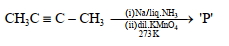
The major product of the following reaction is $P$. Number of oxygen atoms present in product ' $\mathrm{P}$ ' is  . . . . . . . . . .(nearest integer).
Select correct about the following change

$NO_2^+ \to NO_2 \to NO_2^-$

Which of the following compound is optically active?
The correct statement$(s)$ for orthoboric acid is/are

$(A)$ It behaves as a weak acid in water due to self ionization.

$(B)$ Acidity of its aqueous solution increases upon addition of ethylene glycol.

$(C)$ It has a three dimensional structure due to hydrogen bonding.

$(D)$ It is weak electrolyte in water.

Which of the following carbocation most stable?
Let the solubility of an aqueous solution of $Mg{(OH)_2}$ be $x$ then its ${k_{sp}}$ is
The position of equilibrium lies to the right in each of these reactions :

$N_2H_5 ^+ + NH_3$ $\rightleftharpoons $ $NH_4^+ + N_2H_4$

$NH_3 + HBr $ $\rightleftharpoons $ $NH_4^+ + Br^-$

$N_2H_4 + HBr$ $\rightleftharpoons $ $N_2H_5^+ + Br^-$

Based on this information, what is the order of acidic strength -

Conside the following reactions:

$\mathrm{NaCl}+\mathrm{K}_{2} \mathrm{Cr}_{2} \mathrm{O}_{7}+\mathrm{H}_{2} \mathrm{SO}_{4}(\mathrm{Conc} .) \rightarrow(\mathrm{A})+$ Side products

$(\mathrm{A})+\mathrm{NaOH} \rightarrow(\mathrm{B})+$ side product

$(\mathrm{B})+\mathrm{H}_{2} \mathrm{SO}_{4}(\mathrm{dilute})+\mathrm{H}_{2} \mathrm{O}_{2} \rightarrow(\mathrm{C})+$ Side product

The sum of the total number of atoms in one molecule each of $(A), (B)$ and $(C)$ is