MCQ
The $IUPAC$ name of the following compound is
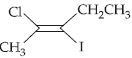
- ✓trans$-{2-}$chloro$-{3-}$iodo$-{2-}$pentene
- Bcis$-{3-}$iodo$-4-$chloro$-{3-}$pentane
- Ctrans$-{3-}$iodo${-4}-$chloro$-{3-}$pentene
- Dcis$-{2-}$chloro$-{3-}$iodo$-{2-}$pentene.
One $Cl$ and one $I$ are present at second and third carbon atom respectively. The molecule has trans geometry across $C = C$ bond.
Hence, it is named trans-$2$-chloro-$3$-iodo-$2$-pentene.
Generate a complete, print-ready paper with questions like this in minutes — across 16+ boards, with answer keys.
|
List$-I$ (Si-Compounds) |
List$-II$ (Si-Polymeric/other products) |
| $(A)$ $\left( CH _{3}\right)_{4} Si$ | $(I)$ Chain silicone |
| $(B)$ $\left( CH _{3}\right) Si ( OH )_{3}$ | $(II)$ Dimeric silicone |
| $(C)$ $\left( CH _{3}\right)_{2} Si ( OH )_{2}$ | $(III)$ Silane |
| $(D)$ $\left( CH _{3}\right)_{3} Si ( OH )$ | $(IV)$ $2 D$ - Silicone |
Choose the correct answer from the options given below
$6CO_2 + 6H_2O + solar energy \to C_6H_{12}O_6+6O_2$
A blue whales gain $75\ kg$ of mass per day by feeding on krill. The whale must consume ten times this mass of krill each day. The krill must consume $10.0\ kg$ of diatoms to produce $1.0\ kg$ of krill. Assuming that the mass gain of a whale's life is due to the consumption of carbohydrates $(C_6H_{12}O_6)$ , calculate the moles of $CO_2$ that must be used by the diatoms to produce the carbohydrates consumed by a blue whale in a day