MCQ
The $IUPAC$ name of the following compound is
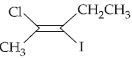
- ✓trans$-{2-}$chloro$-{3-}$iodo$-{2-}$pentene
- Bcis$-{3-}$iodo$-4-$chloro$-{3-}$pentane
- Ctrans$-{3-}$iodo${-4}-$chloro$-{3-}$pentene
- Dcis$-{2-}$chloro$-{3-}$iodo$-{2-}$pentene.
One $Cl$ and one $I$ are present at second and third carbon atom respectively. The molecule has trans geometry across $C = C$ bond.
Hence, it is named trans-$2$-chloro-$3$-iodo-$2$-pentene.
Generate a complete, print-ready paper with questions like this in minutes — across 16+ boards, with answer keys.
$A$. $T _4 > T _3 > T _2 > T _1$
$B.$ The black body consists of particles performing simple harmonic motion.
$C.$ The peak of the spectrum shifts to shorter wavelength as temperature increases.
$D.$ $\frac{ T _1}{ v _1}=\frac{ T _2}{ v _2}=\frac{ T _3}{ v _3} \neq$ constant
$E.$ The given spectrum could be explained using quantisation of energy.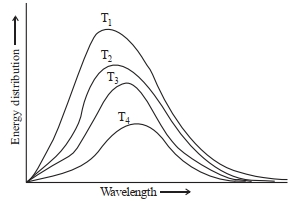
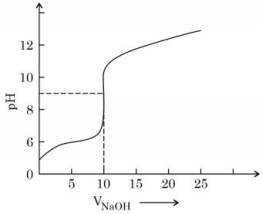
The number of following statements which is/are correct about phenolphthalein is $.....$.
$A$. It can be used as an indicator for the titration of weak acid with weak base.
$B$. It begins to change colour at $pH =8.4$
$C$. It is a weak organic base
$D$. It is colourless in acidic medium