MCQ
The $IUPAC$ name of the following structure $(CH_3)C\cdot C\cdot C\cdot (CH_3)CH(CH_3)$ is :
  • A
    $3-$methyl$-4-$hexynene$-2$
  • $3-$methyl$-2-$hexenyne$-4$
  • C
    $4-$methyl$-4-$hexenyne$-4$
  • D
    all are correct

Answer

Correct option: B.
$3-$methyl$-2-$hexenyne$-4$
b
IUPAC name of the compound is $3$-Methylhex-$2$-en-$4$-yne.

Need a full question paper?

Generate a complete, print-ready paper with questions like this in minutes — across 16+ boards, with answer keys.

Start Generating Free

Similar questions

From the following thermochemical equations, find out the heat of ionisation $Z$ for a weak acid $HA$

$HA \to A^-+ H^+$ , $\Delta H = Z$
$H^+ + OH^-\to H_2O$, $\Delta H = X$
$HA + OH^-\to A^-+ H_2O$, $\Delta H = Y$

Which of the following can act as an acid and as a base
Bond dissociation energy of $E - H$ bond of the " $H _2 E$ " hydrides of group $16$ elements (given below), follows order.

$(A)$ $O$

$(B)$ $S$

$(C)$ $Se$

$(D)$ $Te$
Glucose gives silver mirror with Tollen's reagent. It shows the presence of
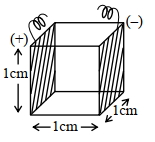
A conductivity cell with two electrodes (dark side) are half filled with infinitely dilute aqueous solution of a weak electrolyte. If volume is doubled by adding more water at constant temperature, the molar conductivity of the cell will -
In a saturated solution of the sparingly soluble strong electrolyte $AgIO_3$ (molecular mass $= 283$) the equilibrium which sets in is

$AgIO_{3(s)} \rightleftharpoons  Ag^+_{(aq)} +IO^-_{3(aq)}.$ 

If the solubility product constant $K_{sp}$ of $AgIO_3$ at a given temperature is $1. 0 \times 10^{-8},$ what is the mass of $AgIO_3$ contained in $100\, ml$ of its saturated saolution ?

A cylinder of gas is assumed to contain $11.2 \,kg $ of butane $({C_4}{H_{10}})$. If a normal family needs $ 20000 \,kJ $ of energy per day. The cylinder will last: (Given that $\Delta H$ for combustion of butane is $ -2658\, kJ$)....$days$
A solution of cyclohexene in benzene is stirred at $0\,^oC$ while concentrated sulphuric acid is added. After washing away the acid and removing the excess  benzene, what product is isolated?
$\begin{array}{*{20}{c}}
  {\,C{H_3}\,\,\,\,\,\,\,\,\,\,\,\,\,} \\ 
  {|\,\,\,\,\,\,\,\,\,\,\,\,\,\,\,\,\,\,} \\ 
  {C{H_3} - C - C{H_2} - \mathop C\limits^ \oplus  {H_2}} \\ 
  {|\,\,\,\,\,\,\,\,\,\,\,\,\,\,\,\,\,\,\,} \\ 
  {C{H_3}\,\,\,\,\,\,\,\,\,\,\,\,\,\,} 
\end{array} \to \begin{array}{*{20}{c}}
  {\,\,\,\,\,\,\,\,\,\,\,C{H_3}} \\ 
  {\,\,\,\,\,\,|} \\ 
  {C{H_3} - \mathop C\limits^ \oplus   - CH - C{H_3}} \\ 
  {\,\,\,\,\,\,|} \\ 
  {\,\,\,\,\,\,\,\,\,\,\,\,\,C{H_3}} 
\end{array}$   

How many ${H^ \ominus }$ shifts are involved in above rearrangement :

Select the incorrect graph for velocity of $e^-$ in an orbit vs. $ Z, \frac {1}{n}$ and $n$