MCQ
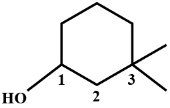
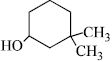
The $IUPAC$ name of the given compound is :
  • A
    $1,1-$ dimethyl $-3-$ hydroxy cyclohexane
  • B
    $3,3-$ dimethyl $-1-$ hydroxy cyclohexane
  • $3,3-$ dimethyl $-1-$ cyclohexanol
  • D
    $1,1-$ dimethyl $-3-$ cyclohexanol

Answer

Correct option: C.
$3,3-$ dimethyl $-1-$ cyclohexanol
c
Hence, IUPAC name is $3,3$-dimethyl-$1$-cyclohexanol

Need a full question paper?

Generate a complete, print-ready paper with questions like this in minutes — across 16+ boards, with answer keys.

Start Generating Free

Similar questions

$\begin{array}{*{20}{c}}
  {C{H_3} - CH - CH = C{H_2} + HBr \to X(product)} \\ 
  {|\,\,\,\,\,\,\,\,\,\,\,\,\,\,\,\,\,\,\,\,\,\,\,\,\,\,\,\,\,\,\,\,\,\,\,\,\,\,\,\,\,\,\,\,\,\,\,\,\,\,\,\,\,\,\,\,\,\,\,\,\,\,\,\,\,\,\,\,\,\,\,\,\,\,\,\,} \\ 
  {C{H_{3\,\,\,\,\,\,\,\,\,\,\,}}\,\,\,\,\,\,\,\,\,\,\,\,\,\,\,\,\,\,\,\,\,\,\,\,\,\,\,\,\,\,\,\,\,\,\,\,\,\,\,\,\,\,\,\,\,\,\,\,\,\,\,\,\,\,\,\,\,\,\,\,\,\,\,} 
\end{array}$

What is the major product i.e. $X$ in the reaction?

The observation of line spectrum of hydrogen atom indicates that
The $\mathrm{pH}$ of an aqueous solution containing $1 \mathrm{M}$ benzoic acid $\left(\mathrm{pK}_{\mathrm{a}}=4.20\right)$ and $1 \mathrm{M}$ sodium benzoate is 4.5 . The volume of benzoic acid solution in 300 $\mathrm{mL}$ of this buffer solution is____ $\mathrm{mL}$.
Considering the chemical properties, atomic weight of $\ce{Be}$ was corrected based on :
Which law states that the total mass of the reactants is equal to the total mass of the products in a chemical reaction?
Consider the following statements for $\overset{\centerdot \,\,\,\,\,\,\,\,\,\,}{\mathop{C{{H}_{3}}}}\,=X$ and $\overset{\centerdot \,\,\,\,\,\,\,\,\,\,}{\mathop{C{{F}_{3}}}}\,=Y$ .
$(I)$ When $X$ dimerises bond angle decreases
$(II)$ When $X$ dimerises bond angle increases
$(III)$ In $X-Y$ molecule $C-C$ bond length is less than that in $Y-Y$ molecule
$(IV)$ Bond angle in $X$ is greater than that in $Y$
Empirical formula of a hydrocarbon containing $80\%$ carbon and $20\%$ hydrogen is
Which of the following is not an electrophile
In $C{H_3}C{H_2}OH,$ the bond that undergoes heterolytic cleavage most readily is
The maxium covalency of aluminium is: