MCQ
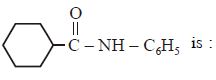
The $IUPAC$ name of
- A$N-$ Cyclohexyl benzamide
- B$N-$ Phenyl $-N-$ cyclohexylmethanamide
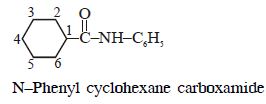
- ✓$N-$ Phenylcyclohexane carboxamide
- D$N-$ Cyclohexyl $-N-$ phenylmethylamide
Generate a complete, print-ready paper with questions like this in minutes — across 16+ boards, with answer keys.
$ 2 \mathrm{~S}_2 \mathrm{O}_3^{2-}+\mathrm{I}_2 \rightarrow \mathrm{S}_4 \mathrm{O}_6^{2-}+2 \mathrm{I}^{-}$
$\mathrm{S}_2 \mathrm{O}_3^{2-}+5 \mathrm{Br}_2+5 \mathrm{H}_2 \mathrm{O} \rightarrow 2 \mathrm{SO}_4^{2-}+4 \mathrm{Br}^{-}+10 \mathrm{H}^{+}$
Which of the following statement justifies the above dual behaviour of thiosulphate?
$A(g)\,\xrightarrow{{{K_1}\, = \,2\, \times \,{{10}^{ - 3}}\,\,{S^{ - 1}}}}2B\,(g)$
$A(g)\,\xrightarrow{{{K_2}\, = \,1\, \times \,{{10}^{ - 3}}\,\,{S^{ - 1}}}}C\,(g)$
|
List$-I$ (Oxide) |
List$-II$ (Nature) |
| $(A)$ $Cl _{2} O _{7}$ | $(I)$ Amphoteric |
| $(B)$ $Na _{2} O$ | $(II)$ Basic |
| $(C)$ $Al _{2} O _{3}$ | $(III)$ Neutral |
| $(D)$ $N _{2} O$ | $(IV)$ Acidic |
Choose the correct answer from the options given below