The $K.E.$ and $P.E.$ of a particle executing $SHM$ with amplitude $A$ will be equal when its displacement is
Medium
Download our app for free and get started
$\mathrm{KE}=\mathrm{PE}$
$\frac{1}{2} \mathrm{m} \omega^{2}\left(\mathrm{A}^{2}-\mathrm{y}^{2}\right)=\frac{1}{2} \mathrm{m} \omega^{2} \mathrm{y}^{2}$
$\Rightarrow \mathrm{y}=\frac{\mathrm{A}}{\sqrt{2}}$

Download our appand get started for free
Experience the future of education. Simply download our apps or reach out to us for more information. Let's shape the future of learning together!No signup needed.*
Similar Questions
- 1Equations $y = 2A \cos ^2 \omega \,t$ and $y = A (\sin \omega t + \cos \omega t )$ represent the motion of two particles.View Solution
- 2View SolutionThe acceleration of a particle in S.H.M. is
- 3A spring is stretched by $5 \,\mathrm{~cm}$ by a force $10 \,\mathrm{~N}$. The time period of the oscillations when a mass of $2 \,\mathrm{~kg}$ is suspended by it is :(in $s$)View Solution
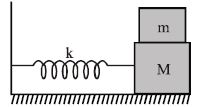
- 4In the arrangement, spring constant $k$ has value $2\,N\,m^{-1}$ , mass $M = 3\,kg$ and mass $m = 1\,kg$ . Mass $M$ is in contact with a smooth surface. The coefficient of friction between two blocks is $0.1$ . The time period of $SHM$ executed by the system isView Solution
- 5If particle is executing simple harmonic motion with time period $T$, then the time period of its total mechanical energy is ...........View Solution
- 6A particle executes simple harmonic motion (amplitude $= A$) between $x = - A$ and $x = + A$. The time taken for it to go from $0$ to $A/2$ is ${T_1}$ and to go from $A/2$ to $A$ is ${T_2}$. ThenView Solution
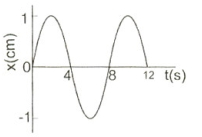
- 7The $x$-t graph of a particle undergoing simple harmonic motion is shown below. The acceleration of the particle at $t=4 / 3 \mathrm{~s}$ isView Solution
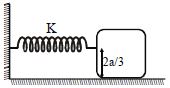
- 8Find maximum amplitude for safe $SHM$ (block does not topple during $SHM$) of $a$ cubical block of side $'a'$ on a smooth horizontal floor as shown in figure (spring is massless)View Solution
- 9Springs of spring constants $K, 2K, 4K, 8K,$ ..... are connected in series. A mass $40\, gm$ is attached to the lower end of last spring and the system is allowed to vibrate. What is the time period of oscillation ..... $\sec$. (Given $K = 2\, N/cm$)View Solution
- 10The ratio of frequencies of two pendulums are $2 : 3$, then their length are in ratioView Solution