MCQ
The lanthanide contraction relates to
  • A
    Atomic radii
  • Atomic as well as ${M^{3 + }}$ radii
  • C
    Valence electrons
  • D
    Oxidation states

Answer

Correct option: B.
Atomic as well as ${M^{3 + }}$ radii
b
(b)The lanthanide contraction relates to atomic as well as ${M^{3 + }}$ radii in which the regular decrease in the size of lanthanoid ion from $L{a^{3 + }}$ to $L{u^{3 + }}$are found.

Need a full question paper?

Generate a complete, print-ready paper with questions like this in minutes — across 16+ boards, with answer keys.
Start Generating Free

Similar questions

The conductivity of a solution of complex with formula $CoCl _{3}\left( NH _{3}\right)_{4}$ corresponds to $1: 1$ electrolyte, then the primary valency of central metal ion is
Which of the following is true about the value of refractive index of quartz glass?
Paramagnetic co-ordination compounds contain ........ electrons
Which oxidised product is obtained when benzene diazonium chloride reacts with ethanol?
The product of reduction of benzaldehyde is
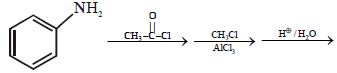
Identify major product of following sequence of reaction
The bad smelling substance formed by the action of alcoholic caustic potash on chloroform and aniline is
The negative $Zn$ pole of a Daniel cell, sending a constant current through a circuit, decreases in mass by $0.13\,g$ in $30$ minutes. If the electrochemical equivalent of $Zn$ and $Cu$ are $32.5$ and $31.5$ respectively, the increase in the mass of the positive $Cu$ pole in this time is .............. $\mathrm{g}$
The $\text{IUPAC}$ name for $\mathrm{CH}_3 \mathrm{CH}(\mathrm{OH}) \mathrm{CH}_2 \mathrm{C}\left(\mathrm{CH}_3\right)_2 \mathrm{OH}$ is:
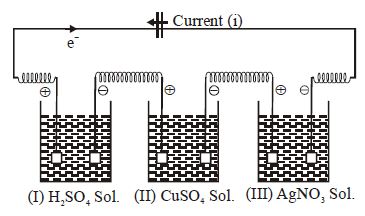
Three voltameters containing and aqueous solution of $H_2SO_4,$ $CuSO_4$ and $AgNO_3$ are connected in the following way

A current was passed for $10$ hours. $10.8\ g Ag$ was deposited at cathode in $(III)$ electrolytic cell during electrolysis if current efficiency is $50\%.$

If $Z_1,$ $Z_2$ and $Z_3$ be the electrochemical equivalent in the formation of $H_2, Cu$ and $Ag$ respectively, hence $Z_1 : Z_2 : Z_3$ would be