MCQ
The Lassiagne's extract is boiled with dil HNO3 before testing for halogens because,
  • A
    AgCN is soluble in $HNO _3$
  • B
    Silver halides are soluble in $HNO _3$
  • C
    $Ag _2 S$ is soluble $HNO _3$
  • $Na _2 S$ and NaCN are decomposed by $HNO _3$

Answer

Correct option: D.
$Na _2 S$ and NaCN are decomposed by $HNO _3$
(D)
If nitrogen or sulphur is also present in the compound, the sodium fusion extract is first boiled with concentrated nitric acid to decompose cyanide or sulphide of sodium during Lassaigne's test

Need a full question paper?

Generate a complete, print-ready paper with questions like this in minutes — across 16+ boards, with answer keys.
Start Generating Free

Similar questions

An element have atomic weight $40$  and it’s electronic configuration is $1{s^2}2{s^2}2{p^6}3{s^2}3{p^6}.$ Then its atomic number and number of neutrons will be
Which of the following decreases on dilution of electrolytic solution ?
Maximum number of isomers of alkene ${C_4}{H_8}$ are
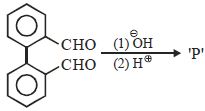
The major product $'P'$ formed in this reaction
Bessemer converter is used in the manufacture of
Sodium ethoxide is a specific reagent for
Which oxoacid of phosphorous has the highest number of oxygen atoms present in its chemical formula?
An aqueous solution of a solute $AB$ has $b.p$ of $101.08\,^{\circ}C (AB$ is $100\%$ ionised in boiling point of the solution $)$ and freezes at $-1.80\,^{\circ}C.$ Hence $,AB\, (K_b / K_f = 0.3)$
Answer the following by appropriately matching the lists based on the information given in the paragraph Consider the Bohr's model of a one$-$electron atom where the electron moves around the nucleus. In the following List$-I$ contains some quantities for the $n^{t /}$ orbit of the atom and List$-II$ contains options showing how they depend on $n$. Which of the following options has the correct combination considering List$-I$ and List$-II$?
List$-I$ List$-II$
$(I)$ Radius of the $n^{\text {th }}$ orbit $(P)\propto n ^{-2}$
$(II)$ Angular momentum of the electron in the $n^{\text {th }}$ orbit $(Q)\propto n ^{-1}$
$(III)$ Kinetic energy of the electron in the $n^{\text {th }}$ orbit $(R)\propto n ^0$
$(IV)$ Potential energy of the electron in the $n^{\text {th }}$ orbit $(S)\propto n ^1$
  $(T)\propto n ^2$
  $(U)\propto n ^{1 / 2}$
$(1)$ Which of the following options has the correct combination considering List$-I$ and List$-II$?
$(1) (II), (R)(2) (I), (P)(3) (I), (T)(4) (II), (Q)$
($2$) Which of the following options has the correct combination considering List$-I$ and List$-II$?
$(1) (III), (S)(2) (IV), (Q)(3) (IV),(U)(4) (III), (P)$
Give the answer or quetion $(1)$ and $(2)$
For the reaction $2S{O_2} + {O_2} \to 2S{O_3}$,the rate of disappearance of $O_2$ is $2.0\times 10^{-4}\  mol\  L^{-1}s^{-1}$. The rate of appearance of $SO_3$ is