MCQ
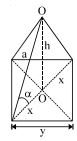
The lateral edge of a regular rectangular pyramid is $'a'$ cm long . The lateral edge makes an angle $\alpha$ with the plane of the base. The value of $\alpha$ for which the volume of the pyramid is greatest, is
  • A
    $\frac{\pi }{4}$
  • B
    $sin^{-1}\sqrt {\frac{2}{3}} $
  • $cot^{-1} \sqrt {2} $
  • D
    $\frac{\pi }{3}$

Answer

Correct option: C.
$cot^{-1} \sqrt {2} $
c
$h = a sin \alpha$ & $x = a cos \alpha $ ;

$x^2 + h^2 = a^2$

$V = \frac{1}{3}y^2 h = \frac{1}{3} 2 x^2 h$   (note $4x^2 = 2y^2 ==> y^2 = 2x^2$)

$V (\alpha ) = \frac{2}{3}a^2 cos^2 \alpha . a sin \alpha = \frac{2}{3}a^3 sin \alpha cos^2 \alpha $

now $ V' (\alpha ) = 0$ ==> $tan \alpha = \frac{1}{{\sqrt 2 }}$ ;

$V_{max} =\frac{{4\,\sqrt 3 \,\,{a^3}}}{{27}}$ 

Need a full question paper?

Generate a complete, print-ready paper with questions like this in minutes — across 16+ boards, with answer keys.

Start Generating Free

Similar questions

The unit vector perpendicular to the plane passing through points $\text{P}\big(\hat{\text{i}}-\hat{\text{j}}+2\hat{\text{k}}\big),\text{Q}\big(2\hat{\text{i}}-\hat{\text{k}}\big)$ and $\text{R}\big(2\hat{\text{j}}+\hat{\text{k}}\big)$ is:

  1. $2\hat{\text{i}}+\hat{\text{j}}+\hat{\text{k}}$

  2. $\sqrt{6}\big(2\hat{\text{i}}+\hat{\text{j}}+\hat{\text{k}}\big)$

  3. $\frac{1}{\sqrt{6}}\big(2\hat{\text{i}}+\hat{\text{j}}+\hat{\text{k}}\big)$

  4. $\frac{1}{6}\big(2\hat{\text{i}}+\hat{\text{j}}+\hat{\text{k}}\big)$

Let $A$ and $B$ be non empty sets in $R$ and $f : A \to B$ is a bijective function.
Statement $1$ : $f$ is an onto function .
Statement $2$ : There exists a function $g : B \to A$ such that $fog = I_B$
If the projection of the vector $\hat{\mathrm{i}}+2 \hat{\mathrm{j}}+\hat{\mathrm{k}}$ on the sum of the two vectors $2 \hat{\mathrm{i}}+4 \hat{\mathrm{j}}-5 \hat{\mathrm{k}}$ and $-\lambda \hat{i}+2 \hat{j}+3 \hat{k}$ is $1,$ then $\lambda$ is equal to ..... .
Choose the correct answer from given four options in each of the Exercise:
The value of the determinant $\begin{vmatrix}\text{x}&\text{x}+\text{y}&\text{x}+2\text{y}\\\text{x}+2\text{y}&\text{x}&\text{x}+\text{y}\\\text{x}+\text{y}&\text{x}+2\text{y}&\text{x}\end{vmatrix}$is:
  1. 9x2(x + y)
  2. 9y2(x + y)
  3. 3y2(x + y)
  4. 7x2(x + y)
$\left| {\,\begin{array}{*{20}{c}}{{a^2} + {x^2}}&{ab}&{ca}\\{ab}&{{b^2} + {x^2}}&{bc}\\{ca}&{bc}&{{c^2} + {x^2}}\end{array}\,} \right|$ is divisor of
If $A = \left[ {\begin{array}{*{20}{c}}4&2\\{ - 1}&1\end{array}} \right]$and $I$ is the identity matrix of order $2$, then $(A - 2I)(A - 3I) = $
The equation of straight line passing through the point $(a, b, c)$ and parallel to $z$ - axis, is
If $\tan (x + y) + \tan (x - y) = 1,$ then ${{dy} \over {dx}} = $
The number of vectors of unit length perpendicular to vectors $a = (1,\,\,1,\,\,0)$ and $b = (0,\,\,1,\,\,1)$ is
If ${\tan ^{ - 1}}x + 2{\cot ^{ - 1}}x = \frac{{2\pi }}{3},$ then $x =$