MCQ
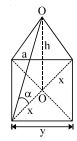
The lateral edge of a regular rectangular pyramid is $'a'$ cm long . The lateral edge makes an angle $\alpha$ with the plane of the base. The value of $\alpha$ for which the volume of the pyramid is greatest, is
  • A
    $\frac{\pi }{4}$
  • B
    $sin^{-1}\sqrt {\frac{2}{3}} $
  • $cot^{-1} \sqrt {2} $
  • D
    $\frac{\pi }{3}$

Answer

Correct option: C.
$cot^{-1} \sqrt {2} $
c
$h = a sin \alpha$ & $x = a cos \alpha $ ;

$x^2 + h^2 = a^2$

$V = \frac{1}{3}y^2 h = \frac{1}{3} 2 x^2 h$   (note $4x^2 = 2y^2 ==> y^2 = 2x^2$)

$V (\alpha ) = \frac{2}{3}a^2 cos^2 \alpha . a sin \alpha = \frac{2}{3}a^3 sin \alpha cos^2 \alpha $

now $ V' (\alpha ) = 0$ ==> $tan \alpha = \frac{1}{{\sqrt 2 }}$ ;

$V_{max} =\frac{{4\,\sqrt 3 \,\,{a^3}}}{{27}}$ 

Need a full question paper?

Generate a complete, print-ready paper with questions like this in minutes — across 16+ boards, with answer keys.

Start Generating Free

Similar questions

If ${({\tan ^{ - 1}}x)^2} + {({\cot ^{ - 1}}x)^2} = \frac{{5{\pi ^2}}}{8},$ then $x$ equals
Function $\text{f}(\text{x})=\cos\text{x}-2\lambda\text{x}$ is monotonic decreasing when :
The sum of distinct values of $\lambda$ for which the system of equations

$(\lambda-1) x+(3 \lambda+1) y+2 \lambda z=0$

$(\lambda-1) x+(4 \lambda-2) y+(\lambda+3) z=0$

$2 x+(3 \lambda+1) y+3(\lambda-1) z=0$

has non-zero solutions, is

The solution of the differential equation $(\text{x}^{2}+1)\frac{\text{dy}}{\text{dx}}+(\text{y}^{2}+1)=0$ is:
Let $A = \{2, 3, 4, 5, ..., 17, 18\}.$ Let $'\simeq\ '$ be the equivalence relation on $A \times A,$ cartesian product of $A$ with itself, defined by $(\text{a, b})\simeq(\text{c, d)}$ if $ad = bc.$ Then, the number of ordered pairs of the equivalence class of $(3, 2)$ is:
The plane $XOZ$ divides the join of $(1,\, - 1,\,\,5)$ and $(2, 3, 4)$ in the ratio $\lambda :1$, then $\lambda $ is
Let $F: R \rightarrow R$ be a thrice differentiable function. Suppose that $F (1)=0, F (3)=-4$ and $F^{\prime}( x )<0$ for all $x \in$ $(1 / 2,3)$. Let $f(x)=x F(x)$ for all $x \in R$.

$1.$ The correct statement$(s)$ is(are)

$(A)$ $f^{\prime}(1) < 0$

$(B)$ $f(2) < 0$

$(C)$ $f^{\prime}(x) \neq 0$ for any $x \in(1,3)$

$(D)$ $f^{\prime}(x)=0$ for some $x \in(1,3)$

$2.$ If $\int_1^3 x^2 F^{\prime}(x) d x=-12$ and $\int_1^3 x^3 F^{\prime \prime}(x) d x=40$, then the correct expression$(s)$ is(are)

$(A)$ $9 f^{\prime}(3)+f^{\prime}(1)-32=0$

$(B)$ $\int_1^3 f(x) d x=12$

$(C)$ $9 f^{\prime}(3)-f^{\prime}(1)+32=0$

$(D)$ $\int_1^3 f(x) d x=-12$

Give the answer question $1$ and $2.$
If $f : [1, \infty ) \rightarrow [2, \infty)$ is given by $\text{f(x)}=\text{x}+\frac{1}{\text{x}},$ then $f^{-1}$ equals to:
If the function $f(x) = {{K\sin x + 2\cos x} \over {\sin x + \cos x}}$ is increasing for all values of $x,$ then
If function $f(x)=\left\{\begin{array}{c}\frac{x^2-16}{x-4}, x \neq 4 \\ k, x=4\end{array}\right.$, is continuous at $x=4$, then value of $k$ is :