MCQ
The law, governing the force between electric charges is known as.
- AAmpere's law.
- BOhm's law.
- CFaraday's law.
- DCoulomb's law.
Generate a complete, print-ready paper with questions like this in minutes — across 16+ boards, with answer keys.
Assertion : Owls can move freely during night.
Reason : They have large number of rods on their retina.
|
(a) If both assertion and reason are true and the reason is the correct explanation of the assertion. |
|
(b) If both assertion and reason are true but reason is not the correct explanation of the assertion. |
|
(c) If assertion is true but reason is false. |
|
(d) If the assertion and reason both are false. |
When white light passes through the achromatic combination of prisms, then what is observed
|
(a) Only deviation |
(b) Only dispersion |
|
(c) Deviation and dispersion |
(d) None of the above |
Assertion : In photoelectric effect, on increasing the intensity of light, both the number of electrons emitted and kinetic energy of each of them get increased but photoelectric current remains unchanged.
Reason : The photoelectric current depends only on wavelength of light.
|
(a) If both assertion and reason are true and the reason is the correct explanation of the assertion. |
|
(b) If both assertion and reason are true but reason is not the correct explanation of the assertion. |
|
(b) If both assertion and reason are true but reason is not the correct explanation of the assertion. |
|
(d) If the assertion and reason both are false. |
The maximum value of stopping potential in the following diagram is
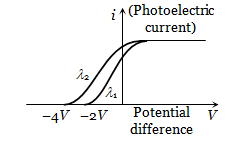
|
(a) – 4V |
(b) – 1V |
(c) – 3V |
(d) – 2V |
A point charge +q is placed at the centre of a cube of side L. The electric flux emerging from the cube is
|
(a) |
(b) Zero |
(c) |
(d) |


