MCQ
The least number of oxyacids are formed by
  • A
    Chlorine
  • B
    Nitrogen
  • Fluorine
  • D
    Sulphur

Answer

Correct option: C.
Fluorine
c
boiling point order is $C$ because of higher van der waals' forces of attraction in $HI$ and increase of atomic size.

Need a full question paper?

Generate a complete, print-ready paper with questions like this in minutes — across 16+ boards, with answer keys.

Start Generating Free

Similar questions

$29.2 \%(w / w) HCl ^2$ stock solution has a density of $1.25 \ g mL ^{-1}$. The molecular weight of $HCl$ is $36.5 \ g mol ^{-1}$. The volume $( mL )$ of stock solution required to prepare a $200 \ mL$ solution of $0.4 \ M HCl$ is :
$AgCl$ dissolves in a solution of $N{H_3}$ but not in water because
an oxidation-reduction reaction in which $3$ electrons are transferred has a $\Delta G ^{\circ}$ of $17.37\, kJ$ $mol ^{-1}$ at $25^{\circ} C$. The value of $E _{\text {cell }}^{\circ}$ (in $V$ ) is........ $\times 10^{-2}$

$\left(1 F =96,500\, C\, mol ^{-1}\right)$

The major product ' $P$ ' formed in the given reaction is
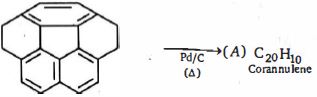
The step shown below is a recent synthesis of corannulene.

Product $(A)$ is

For the process
$A(g) + e^-\to  A^-(g);$                   $\Delta H = x$
and $A^-(g) \to A(g) + e^-$              $\Delta H = y$
Select correct alternate :
Given below are two statement one is labeled as 
Assertion (A) and the other is labeled as Reason (R). 
Assertion (A): $CH _2$. = CH – CH2 – Cl is an example of allyl halide 
Reason (R): Allyl halides are the compounds in which the halogen atom is attached to $sp ^2$ hybridised carbon atom.
In the light of the two above statements, choose the most appropriate answer from the options given below: 
The density of a monobasic strong acid (Molar mass $24.2\,g\,mol )$ is $1.21\,kg\,L$. The volume of its solution required for the complete neutralization of $25\,mL$ of $0.24\,M\,NaOH$ is $..............\times 10^{-2}\,mL$ (Nearest integer)
One mole of an organic compound requires $0.5$ mole of oxygen to produce an acid. The compound may be
Other than the $X-$ ray diffractions, how could be the following pairs of isomers be distinguished from one another by

$[Cr(NH_3)_6] [Cr(NO_2)_6]$ and $[Cr(NH_3)_4(NO_2)_2] \,[Cr(NH_3)_2(NO_2)_4]$