MCQ
The length of the wire is doubled. Its conductance will be
  • A
    Unchanged
  • Halved
  • C
    Quadrupled
  • D
    $1/4$ of the original value

Answer

Correct option: B.
Halved
b
(b) Conductance $C = \frac{1}{R} = \frac{A}{{\rho l}}\, \Rightarrow \,C \propto \frac{1}{l}$

Need a full question paper?

Generate a complete, print-ready paper with questions like this in minutes — across 16+ boards, with answer keys.

Start Generating Free

Similar questions

A $50 \,volt$ potential difference is suddenly applied to a coil with $L = 5 \times {10^{ - 3}}$ henry and $R = 180\,ohm$. The rate of increase of current after $0.001$ $second$ is.......$ amp/sec$
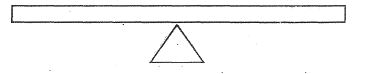
A uniform rod of mass $'m'$ and length $'2l'$ is balanced on triangular prism. Now length $\frac {l}{2}$ of rod is cut from one end and placed over the  shortened part such that the ends meet. The initial angular acceleration is
Two persons $A$ and $B$, each carrying a source of sound of frequency $n$, are standing a few metres apart in a quiet field. $A$ starts moving towards $B$ with a speed $u$. If $v$ is the speed of sound, the number of beats heard per second by $A$ will be
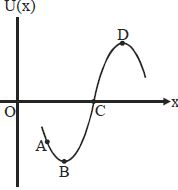
Potential energy of a particle varies with distance $x$ as shown in the graph Select the wrong statement
The tidal waves in the sea are primarily due to
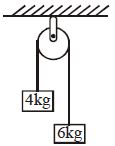
For the pulley system the kinetic energy of the $6\,kg$ block after $5\,s$ is ............ $\mathrm{J}$
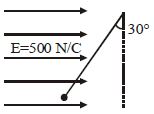
The tiny ball at the end of the thread shown in figure has a mass of $0.5 \, g$ and is  placed in a horizontal electric field of intensity $500\, N/C$. It is in equilibrium in the  position shown. The magnitude and sign of the charge on the ball is .....$\mu C$
In a balanced Wheatstone’s network, the resistances in the arms $Q$ and $S$ are interchanged. As a result of this
$A$ bi-concave glass lens having refractive index $1.5$ has both surfaces of same radius of curvature $R$. On immersion in a medium of refractive index $1.75$, it will behave as a
A tuning fork of known frequency $256\,Hz$ makes $5$ beats per second with the vibrating string of a piano. The beat frequency decreases to $2$ beats per second when the tension in the piano string is slightly increased. The frequency of the piano string before increasing the tension was