MCQ
The line on the earth's surface joining the points where the field is horizontal is
  • A
    Magnetic meridian
  • B
    Magnetic axis
  • C
    Magnetic line
  • Magnetic equator

Answer

Correct option: D.
Magnetic equator
d
(d) Any magnetic field is a vector and can be resolved into horizontal and vertical components.

The earth's magnetic field starts from the magnetic north pole and ends at the south one.

At the poles the field is perpendicular to the ground upto a certain height and then it curves and turns. Thus, at the pole, the field is completely vertical and has no horizontal component. This happens only at the poles.

At the magnetic equator, the field is completely horizontal and has no vertical component.

The line joining the geographic poles of the earth is known as geographic axis. The magnetic axis can be defined in a similar way. The two axes do not coincide and are slightly inclined to each other and they intersect at the centre. This is because the geographic poles and the magnetic poles do not coincide. The Magnetic field is independent of the geographic poles.

A latitude of the earth at a point on the earth surface is the angle made by the line joining that point and the earth's centre with the equatorial plane. At a latitude of $45^{0}$, the point on the earth surface is between the pole and the equator. Here the field has equal horizontal and vertical components.

Need a full question paper?

Generate a complete, print-ready paper with questions like this in minutes — across 16+ boards, with answer keys.
Start Generating Free

Similar questions

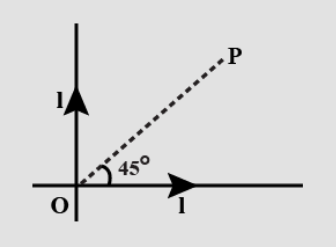
Two infinite long wires, each carrying current $I,$ are lying along $x -$ axis and $y -$ axis, respectively. A charged particle, having a charge $q$ and mass $m,$ is projected with a velocity $u$ along the straight line $OP$. The path of the particle is $($neglect gravity$)$ a:
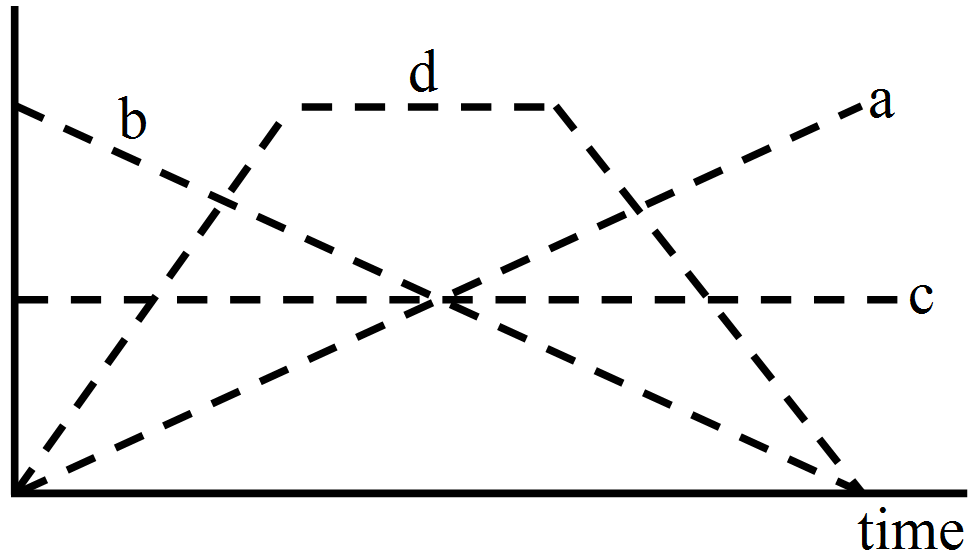
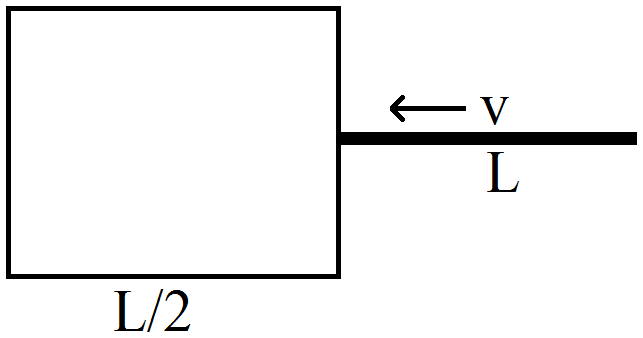
Figure shows an imaginary cube of edge $\frac{\text{L}}{2}.$ A uniformly charged rod of length $L$ moves towards left at a small but constant speed u. At $t = 0$, the left end just touches the centre of the face of the cube opposite it. Which of the graphs shown in figure represents the flux of the electric field through the cube as the rod goes through it?

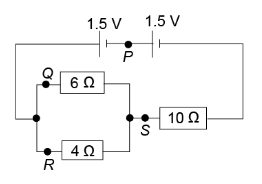
In the circuit shown here, at which point is the current least?
If Young's double slit experiment is performed in water:
An electron collides with a fixed hydrogen atom in its ground state. Hydrogen atom gets excited and the colliding electron loses all its kinetic energy. Consequently the hydrogen atom may emit a photon corresponding to the largest wavelength of the Balmer series. The min. $K.E.$ of colliding electron will be.....$eV$
The current flowing in a coil of resistance $90 \,\Omega$ is to be reduced by $90\%$. What value of resistance should be connected in parallel with it ............. $\Omega $
A convex lens of focal length $40 \mathrm{~cm}$ forms an image of an extended source of light on a photoelectric cell. A current I is produced. The lens is replaced by another convex lens having the same diameter but focal length $20 \mathrm{~cm}$. The photoelectric current now is:
Name of the India's first nuclear reactor is
The dimensions of capacitance are:
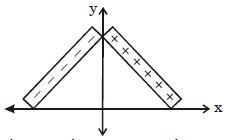
Diagram shows symmetrically placed rectangular insulators with uniformly charged distributions of equal magnitude. At the origin, the net field net ${\vec E_{net}}$ is :-