MCQ
The local maximum value of the function $f(x)=\left(\frac{2}{x}\right)^{x^{2}}, x>0$, is
  • A
    $(2 \sqrt{\mathrm{e}})^{\frac{1}{\mathrm{e}}}$
  • B
    $\left(\frac{4}{\sqrt{\mathrm{e}}}\right)^{\frac{\mathrm{e}}{4}}$
  • $(\mathrm{e})^{\frac{2}{\mathrm{e}}}$
  • D
    $1$

Answer

Correct option: C.
$(\mathrm{e})^{\frac{2}{\mathrm{e}}}$
c
$f(x)=\left(\frac{2}{x}\right)^{x^{2}} ; x>0$

$\ell n f(x)=x^{2}(\ell \ln 2-\ell n x)$

$f^{\prime}(x)=f(x)\{-x+(\ell n 2-\ell n x) 2 x\}$

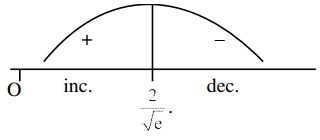
$f^{\prime}(x)=\underbrace{f(x)}_{+} \cdot \underbrace{x}_{+} \underbrace{(2 \ell n 2-2 \ell n x-1)}_{g(x)}$

$g(x)=2 \ell n^{2}-2 \ell n x-1$

$=\ell n \frac{4}{x^{2}}-1=0 \Rightarrow x=\frac{2}{\sqrt{e}}$

$\mathrm{LM}=\frac{2}{\sqrt{\mathrm{e}}}$

Local maximum value $=\left(\frac{2}{2 / \sqrt{\mathrm{e}}}\right)^{\frac{4}{\mathrm{e}}} \Rightarrow \mathrm{e}^{\frac{2}{\mathrm{e}}}$
Need a full question paper?

Generate a complete, print-ready paper with questions like this in minutes — across 16+ boards, with answer keys.

Start Generating Free

Similar questions

$\int_{}^{} {\frac{{\tan (\log x)}}{x}\;dx = } $
If the function $\text{f}(\text{x})=\cos|\text{x}|-2\text{ax}+\text{b}$ increases along entire number scale, then:
The positive values of the parameter $'a'$ for which the area of the figure bounded by the curve $y = \cos ax, y = 0, x = \frac{\pi }{{6\,a}} , x =  \frac{5\pi }{{6\,a}} $ is greater than $3$ are :
If $X = \left[ {\begin{array}{*{20}{c}}{ - x}&{ - y}\\z&t\end{array}} \right]$ then transpose of adj $X$  is
Let $S$ be the region bounded by the curves $y=x^{3}$ and $y ^{2}= x$. The curve $y =2| x |$ divides $S$ into two regions of areas $R_{1}$ and $R_{2}$.

If $\max \left\{R_{1}, R_{2}\right\}=R_{2}$, then $\frac{R_{2}}{R_{1}}$ is equal to

If $y = {{\tan x + \cot x} \over {\tan x - \cot x}},$ then ${{dy} \over {dx}} = $
$A = \left[ {\begin{array}{*{20}{c}}4&6&{ - 1}\\3&0&2\\1&{ - 2}&5\end{array}} \right]$,$B = \left[ {\begin{array}{*{20}{c}}2&4\\0&1\\{ - 1}&2\end{array}} \right],\,\,C = \left[ {\begin{array}{*{20}{c}}3\\1\\2\end{array}} \right]$, then the expression which is not defined is
Let $\vec{a}=\hat{i}+2 \hat{j}+\lambda \hat{k}, \vec{b}=3 \hat{i}-5 \hat{j}-\lambda \hat{k}, \vec{a} \cdot \vec{c}=7$, $2 \vec{b} \cdot \vec{c}+43=0, \vec{a} \times \vec{c}=\vec{b} \times \vec{c}$. Then $|\vec{a} \cdot \vec{b}|$ is equal to
Derivative of $e^{\sin ^2 x}$ with respect to $\cos x$ is
A random variable $X$ has the following probability distribution

$X$ $1$ $2$ $3$ $4$ $5$
$P(X)$ $K^2$ $2K$ $K$ $2K$ $5K^2$

Then $\mathrm{P}(\mathrm{X}> 2)$ is equal to