MCQ
The locus of  a point equidistant from two given points $ a$  and $ b $ is given by
  • $[r - \frac{1}{2}(a + b)]\,.\,\,(a - b) = 0$
  • B
    $[r - \frac{1}{2}(a - b)]\,.\,\,(a + b) = 0$
  • C
    $[r - \frac{1}{2}(a + b)].(a + b) = 0$
  • D
    $[r - \frac{1}{2}(a - b)]\,.\,\,(a - b) = 0$
Answer

Correct option: A.
$[r - \frac{1}{2}(a + b)]\,.\,\,(a - b) = 0$
a
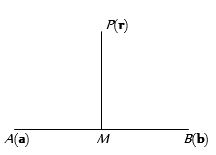
(a) Let $P(r)$ be equidistant from $A\,\,(a)$ and $B\,\,(b)$ and $PM$ be perpendicular to $AB.$

Then $M$ is the mid point of $AB.$

$\therefore $ Position vector of $M$ is $\frac{1}{2}(a + b).$

$\overrightarrow {PM} \,.\,\overrightarrow {BA} = 0$ or $\left[ {r - \frac{1}{2}(a + b)} \right]\,.\,(a - b) = 0.$

Need a full question paper?

Generate a complete, print-ready paper with questions like this in minutes — across 16+ boards, with answer keys.

Start Generating Free

Similar questions

The vector equation of the plane containing the line $\vec{\text{r}}=(-2\hat{\text{i}}-3\hat{\text{j}}+\hat{\text{k}})+\lambda(3\hat{\text{i}}-2\hat{\text{j}}-\hat{\text{k}})$ and the point $\hat{\text{i}}+2\hat{\text{j}}+3\hat{\text{k}}$ is:
Let  ${\tan ^{ - 1}}\left( {\tan \frac{{5\pi }}{4}} \right) = \alpha ,{\tan ^{ - 1}}\left( { - \tan \frac{{2\pi }}{3}} \right) = \beta $ Then :-
If ${I_n} = {{{d^n}} \over {d{x^n}}}({x^n}\log x),$ then ${I_n} - n{I_{n - 1}} = $
Let the relation $R$ in the set $A=\{x \in Z: 0 \leq x \leq 12\}$, given by $R=\{(a, b):|a-b|$ is a multiple of 4. $\}$ Then [1], the equivalence class containing 1 , is
Inverse of the function $y = 2x - 3$ is
Let $\ln x$ denote the logarithm of $x$ with respect to the base $e$. Let $S \subset R$ be the set of all points where the function $\ln \left(x^2-1\right)$ is well-defined. Then, the number of functions $f: S \rightarrow R$ that are differentiable, satisfy $f^{\prime}(x)=\ln \left(x^2-1\right)$ for all $x \in S$ and $f(2)=0$, is
The vector $2\,i + a\,j + k$ is perpendicular to the vector $2\,i - j - k,$ if $a = $
The slope of the tangent to the curve x = t2 + 3 t - 8, y = 2t2 - 2t - 5 at point (2, -1) is:
  1. $\frac{22}{7}$
  2. $\frac{6}{7}$
  3. $-6$
  4. $\text{None of these}$
Let $g\left( x \right) = \cos {x^2},f\left( x \right) = \sqrt x $ and $\alpha ,\beta (\alpha < \beta )$ be the roots of the quadratic equation $18{x^2} - 9\pi x + {\pi ^2} = 0$. Then the area (in sq. units) bounded by the curve $y = \left( {gof} \right)\left( x \right)$ and the lines $x = \alpha ,x = \beta $ and $y = 0$ is :
Choose the correct option from given four options:
$\int\frac{\text{x}}{\text{x}+1}$ is equal to:
  1. $\text{x}+\frac{\text{x}^2}{2}+\frac{\text{x}^3}{3}-\log|1-\text{x}|+\text{C}$
  2. $\text{x}+\frac{\text{x}^2}{2}-\frac{\text{x}^3}{3}-\log|1-\text{x}|+\text{C}$
  3. $\text{x}-\frac{\text{x}^2}{2}-\frac{\text{x}^3}{3}-\log|1+\text{x}|+\text{C}$
  4. $\text{x}-\frac{\text{x}^2}{2}+\frac{\text{x}^3}{3}-\log|1+\text{x}|+\text{C}$