Question
The logarithmic function expressed as $\log _e R^{+} \rightarrow R$ and given by $\log _e x=y$ iff $e^y=x$. The graph of the function is given below :
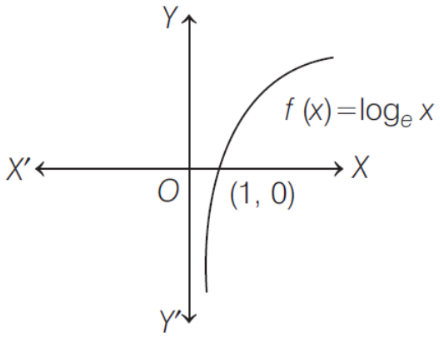
Image
(i) Domain of $f(x)=(0, \infty)$ or $R^{+}$
(ii) Range of $f(x)=(-\infty, \infty)$ or $R$

To find the limit of functions involving logarithmic function, we use the following theorem Theorem $\lim _{x \rightarrow 0} \frac{\log _e(1+x)}{x}=1$

Based on above information, answer the following questions.

(i) $\lim _{x \rightarrow 0} \frac{\log _e(1+5 x)}{x}$ is equal to
    (a) 5     (b) 4     (c) 3     (d) 1

(ii) $\lim _{x \rightarrow 0} \frac{\log _e(1+6 x)-5 x^2}{x}$ is equal to
    (a) 1     (b) 2     (c) 3     (d) 6

(iii) $\quad \lim _{x \rightarrow 0} \frac{\sqrt{1+x}-1}{\log (1+x)}$ is equal to
    (a) 1     (b) $\frac{1}{2}$     (c) $\frac{1}{3}$     (d) $\frac{3}{2}$

(iv) $\quad \lim _{x \rightarrow 5} \frac{\log x-\log 5}{x-5}$ is equal to
    (a) $\frac{1}{5}$     (b) $\frac{3}{5}$     (c) $\frac{1}{4}$     (d) $\frac{2}{3}$

(v) $\quad \lim _{x \rightarrow 0} \frac{\log (5+x)-\log (5-x)}{x}$ is equal to
    (a) $\frac{1}{5}$     (b) $\frac{2}{5}$     (c) $\frac{3}{5}$     (d) $\frac{4}{5}$

Answer

(i)
We have, $\lim _{x \rightarrow 0} \frac{\log _e(1+5 x)}{x}$
$
\begin{aligned}
& =5 \lim _{5 x \rightarrow 0} \frac{\log _e(1+5 x)}{5 x}=5 \times 1=5 \\
& {[\because x \rightarrow 0 \Rightarrow 5 x \rightarrow 0]}
\end{aligned}
$

(ii)
We have, $\lim _{x \rightarrow 0} \frac{\log _{\ell}(1+6 x)-5 x^2}{x}$
$
\begin{aligned}
& =6 \lim _{6 x \rightarrow 0} \frac{\log _e(1+6 x)}{6 x}-5 \lim _{x \rightarrow 0} x \\
& {[\because x \rightarrow 0 \Rightarrow 6 x \rightarrow 0]} \\
& =6 \times(1)-5 \times(0)=6
\end{aligned}
$

(iii)
$
\lim _{x \rightarrow 0} \frac{\sqrt{1+x}-1}{\log (1+x)}
$
On multiplying numerator and denominator by $\sqrt{1+x}+1$, we get

$\begin{aligned} \lim _{x \rightarrow 0} & \frac{\sqrt{1+x}-1}{\log (1+x)} \times \frac{\sqrt{1+x}+1}{(\sqrt{1+x}+1)} \\ & =\lim _{x \rightarrow 0} \frac{1+x-1}{(\sqrt{1+x}+1) \log (1+x)} \\ & =\lim _{x \rightarrow 0} \frac{x}{(\sqrt{1+x}+1) \log (1+x)} \\ & =\frac{1}{(\sqrt{1+0}+1)} \lim _{x \rightarrow 0} \frac{1}{\frac{\log (1+x)}{x}} \\ & =\frac{1}{1+1} \times \frac{1}{\lim _{x \rightarrow 0} \frac{\log (1+x)}{x}} \\ & =\frac{1}{1+1} \times 1=\frac{1}{2}\end{aligned}$

(iv)
Put $x-5=h$ and as $x \rightarrow 5$, then $h \rightarrow 0$
$
\begin{aligned}
& \therefore \lim _{h \rightarrow 0} \frac{\log (h+5)-\log 5}{h} \\
& =\lim _{\frac{h}{5} 0} \frac{\log \left(1+\frac{h}{5}\right)}{\frac{h}{5} \times 5}=\frac{1}{5} \\
& {\left[\begin{array}{rl}
\because \log m-\log n & =\log \frac{m}{n}, \\
h \rightarrow 0 & \Rightarrow \frac{h}{5} \rightarrow 0
\end{array}\right]} \\
&
\end{aligned}
$

(v)
$
\begin{gathered}
\lim _{x \rightarrow 0} \frac{\log \left\{5\left(1+\frac{x}{5}\right)\right\}-\log \left\{5\left(1-\frac{x}{5}\right)\right\}}{x} \\
=\lim _{x \rightarrow 0} \frac{\left\{\log 5+\log \left(1+\frac{x}{5}\right)\right\}-\left\{\log 5+\log \left(1-\frac{x}{5}\right)\right\}}{x} \\
=\lim _{\frac{x}{5} \rightarrow 0} \frac{1}{5} \frac{\log \left(1+\frac{x}{5}\right)}{\frac{x}{5}}-\lim _{\frac{x}{5} \rightarrow 0} \frac{\log \left(1-\frac{x}{5}\right)}{-\frac{x}{5}} \cdot \frac{1}{(-5)}
\end{gathered}
$
$\begin{aligned} & {\left[\because x \rightarrow 0 \Rightarrow \frac{x}{5} \rightarrow 0\right]} \\ & =\frac{1}{5} \times(1)+\frac{1}{5} \times(1)=\frac{2}{5}\end{aligned}$

Need a full question paper?

Generate a complete, print-ready paper with questions like this in minutes — across 16+ boards, with answer keys.

Start Generating Free

Similar questions

Republic day is a national holiday of India. It honours the date on which the constitution of India came into effect on 26 January 1950 replacing the Government of India Act (1935) as the governing document of India and thus, turning the nation into a newly formed republic.

Answer the following question, which are based on the word "REPUBLIC".


(i) Find the number of arrangements of the letters of the word 'REPUBLIC'.
(a) 40300     (b) 30420    (c) 40320     (d) 40400

(ii) How many arrangements start with a vowel?
(a) 12015     (b) 15120     (c) 12018     (d) 15100

(iii) Which concept is used for finding the arrangements start with a vowel?
(a) Permutation     (b) FPM     (c) Combination     (d) FPA

(iv) If the number of arrangements of the letters of the word 'REPUBLIC' is abcde, the (a + b + $\mathbf{c}+\mathbf{d}+\mathbf{e})$ is
(a) 10     (b) 9     (c) 8     (d) 15

(v) If the number of arrangements start with a vowel is abcde, then $(\mathbf{a}+\mathbf{b})-(\mathbf{d}+\mathbf{e})$ is
(a) 2     (b) 3     (c) 4     (d) 5
A function $f$ is said to be a rational function, if $f(x)=\frac{g(x)}{h(x)}$, where $g(x)$ and $h(x)$ are polynomial functions such that $h(x) \neq 0$.
Then, $\lim _{x \rightarrow a} f(x)=\lim _{x \rightarrow a} \frac{g(x)}{h(x)}$
$
=\frac{\lim _{x \rightarrow a} g(x)}{\lim _{x \rightarrow a} h(x)}=\frac{g(a)}{h(a)}
$
However, if $h(a)=0$, then there are two cases arise,
(i) $g(a) \neq 0$
(ii) $g(a)=0$. In the first case, we say that the limit does not exist.
In the second case, we can find limit.

Based on above information, answer the following questions.

(i) $\lim _{x \rightarrow-1}\left(\frac{x^{10}+x^5+1}{x-1}\right)$ is equal to
    (a) $\frac{1}{2}$     (b) $\frac{-1}{2}$     (c) 2     (d) $\frac{3}{2}$

(ii) $\lim _{x \rightarrow-1} \frac{(x-1)^2+3 x^2}{\left(x^4+1\right)^2}$ is equal to
    (a) $\frac{7}{4}$     (b) $\frac{6}{5}$     (c) $\frac{4}{7}$     (d) $\frac{3}{4}$

(iii) The value of $\lim _{x \rightarrow 2}\left[\frac{x^2-4}{x^3-4 x^2+4 x}\right]$ is
    (a) 0     (b) 1     (c) 2     (d) Does not exist

(iv) $\lim _{x \rightarrow 1} \frac{x^7-2 x^5+1}{x^3-3 x^2+2}$ is equal to
    (a) 0     (b) 1     (c) 2     (d) 3

(v) $\lim _{x \rightarrow 0} \frac{\sqrt{1+x^3}-\sqrt{1-x^3}}{x^2}$ is equal to
    (a) 1     (b) 0     (c) -1     (d) 2
Read the following text carefully and answer the questions that follow: Representation of a Relation
A relation can be represented algebraically by roster form or by set-builder form and visually it can be represented by an arrow diagram which are given below
i. Roster form In this form, we represent the relation by the set of all ordered pairs belongs to R.
ii. Set-builder form In this form, we represent the relation $R$ from set $A$ to set $B$ as $R=\{(a, b): a \in A, b \in B$ and the rule which relate the elements of A and B \}.
iii. Arrow diagram To represent a relation by an arrow diagram, we draw arrows from first element to second element of all ordered pairs belonging to relation R. 
Questions
i. If n(A) = 3 and B = {2, 3, 4, 6, 7, 8} then find the number of relations from A to B. (1)
ii. If A = {a, b} and B = {2, 3}, then find the number of relations from A to B. (1)
iii. If A = {a, b} and B = {2, 3}, write the relation in set-builder form. (2) 
OR
Express of $R =\{( a , b ): 2 a + b =5 ; a , b \in W \}$ as the set of ordered pairs (in roster form). (2)