Question
The logic behind $‘NOR’$ gate is that it gives

Answer

(a)The Boolean expression for $ ‘NOR’$ gate is $Y = \overline {A + B} $
i.e. if $A = B = 0$(Low), $Y = \overline {0 + 0} = \bar 0 = 1$(High)

Need a full question paper?

Generate a complete, print-ready paper with questions like this in minutes — across 16+ boards, with answer keys.
Start Generating Free

Similar questions

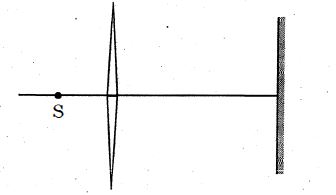
A biprism experiment is set up as shown. When upper half area of the biprism is covered with an opaque material then
A $43\, m$ long rope of mass $5.0\, kg$ joins two rock climbers. One climber strikes the  rope and the second one feels the effect $1.4\, s$ later. What is the tension in the rope .... $N$ ?
A nucleus ${ }^{220} X$ at rest decays emitting an a-particle. If energy of daughter nucleus is $0.2\, MeV$, $Q$ value of the reaction is ........ $MeV$
Magnetic lines of force
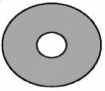
A circular metallic disc of radius $R$ has a small circular cavity of radius $r$ as shown in figure. On heating the system
A laser beam can be focussed on an area equal to the square of its wavelength A $He-Ne$  laser radiates energy at the rate of $1\,mW$ and its wavelength is $632.8 \,nm$. The intensity of focussed beam will be
A proton, a deutron and an $\alpha$-particle having the same momentum, enters a region of uniform electric field between the parallel plates of a capacitor. The electric field is perpendicular to the initial path of the particles. Then the ratio of deflections suffered by them is
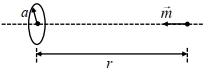
A special metal $S$ conducts electricity without any resistance. A closed wire loop, made of $S$, does not allow any change in flux through itself by inducing a suitable current to generate a compensating flux. The induced current in the loop cannot decay due to its zero resistance. This current gives rise to a magnetic moment which in turn repels the source of magnetic field or flux. Consider such a loop, of radius $a$, with its center at the origin. A magnetic dipole of moment $m$ is brought along the axis of this loop from infinity to a point at distance $r \gg a)$ from the center of the loop with its north pole always facing the loop, as shown in the figure below.

The magnitude of magnetic field of a dipole $m$, at a point on its axis at distance $r$, is $\frac{\mu_0}{2 \pi} \frac{m}{r^3}$, where $\mu_0$ is the permeability of free space. The magnitude of the force between two magnetic dipoles with moments, $m_1$ and $m_2$, separated by a distance $r$ on the common axis, with their north poles facing each other, is $\frac{k m_1 m_2}{r^4}$, where $k$ is a constant of appropriate dimensions. The direction of this force is along the line joining the two dipoles.

($1$) When the dipole $m$ is placed at a distance $r$ from the center of the loop (as shown in the figure), the current induced in the loop will be proportional to

$(A)$ $\frac{m}{r^3}$ $(B)$ $\frac{m^2}{r^2}$ $(C)$ $\frac{m}{r^2}$ $(D)$ $\frac{m^2}{r}$

($2$) The work done in bringing the dipole from infinity to a distance $r$ from the center of the loop by the given process is proportional to

$(A)$ $\frac{m}{r^5}$ $(B)$ $\frac{m^2}{r^5}$ $(C)$ $\frac{m^2}{r^6}$ $(D)$ $\frac{m^2}{r^7}$

Give the answer or qution ($1$) and ($2$)
An ideal heat engine working between temperature $T_1$ and $T_2 $ has an efficiency $\eta$, the new efficiency if both the source and sink temperature are doubled, will be
Projectiles $A$ and $B$ are thrown at angles of $45^{\circ}$ and $60^{\circ}$ with vertical respectively from top of a $400 \mathrm{~m}$ high tower. If their ranges and times of flight are same, the ratio of their speeds of projection $v_A: v_B$ is :