MCQ
The longitudinal strain is only possible in
  • A
    Gases
  • B
    Fluids
  • Solids
  • D
    Liquids

Answer

Correct option: C.
Solids
c
(c)

Need a full question paper?

Generate a complete, print-ready paper with questions like this in minutes — across 16+ boards, with answer keys.
Start Generating Free

Similar questions

The relation between phase difference  $ (\Delta \phi) $ and path difference $ (\Delta x) $ is
The phase difference between two waves, represented by ${y_1} = {10^{ - 6}}\sin \left\{ {100t + \left( {x/50} \right) + 0.5} \right\}\ m$ , ${y_2} = {10^{ - 6}}\cos \left\{ {100t + \left( {\frac{x}{{50}}} \right)} \right\}\ m$ where $x$ is expressed in metres and $t$ is expressed in seconds, is approximately .... $radians$
Force constant of a spring $(K)$ is synonymous to
The angular speed of seconds needle in a mechanical watch is
Inertia is that property of a body by virtue of which the body is
If the resultant of $n$ forces of different magnitudes acting at a point is zero, then the minimum value of $n$ is
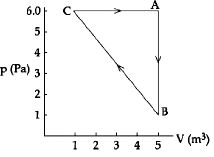
For the given cyclic process $CAB$ as shown for a gas, the work done is ..... $J$
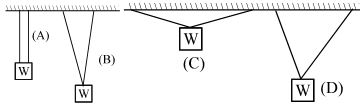
A weight can be hung in any of the following four ways by string of same type. In which case is the string most likely to break?
A ball of mass $m$ is thrown upward and another ball of same mass is thrown downward so as to move freely under gravity. The acceleration of centre of mass is .........
Two ideal Carnot engines operate in cascade (all heat given up by one engine is used by the other engine to produce work) between temperatures, $\mathrm{T}_{1}$ and $\mathrm{T}_{2} .$ The temperature of the hot reservoir of the first engine is $\mathrm{T}_{1}$ and the temperature of the cold reservoir of the second engine is $\mathrm{T}_{2} . T$ is temperature of the sink of first engine which is also the source for the second engine. How is $T$ related to $\mathrm{T}_{1}$ and $\mathrm{T}_{2}$, if both the engines perform equal amount of work?