MCQ
The Lyman transitions involve:
- ALargest changes of energy.
- BSmallest changes of energy.
- CLargest changes of potential energy.
- DSmallest changes of potential energy.
Generate a complete, print-ready paper with questions like this in minutes — across 16+ boards, with answer keys.
A potential difference of 300 volts is applied to a combination of 2.0mF and 8.0mF capacitors connected in series. The charge on the 2.0mF capacitor is
|
(a) 2.4 |
(b) 4.8 |
(c) 7.2 |
(d) 9.6 |
The k line of singly ionised calcium has a wavelength of 393.3 nm as measured on earth. In the spectrum of one of the observed galaxies, this spectral line is located at 401.8 nm. The speed with which the galaxy is moving away from us, will be
|
(a) 6480 km/s |
(b) 3240 km/s |
(c) 4240 km/sec |
(d) None of these |
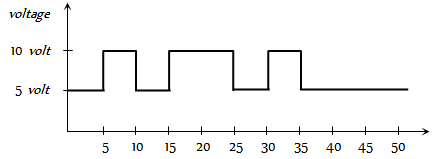
In a negative logic the following wave form corresponds to the
|
(a) 0000000000 |
(b) 0101101000 |
(c) 1111111111 |
(d) 1010010111 |
Dark lines on solar spectrum are due to
|
(a) Lack of certain elements |
|
(b) Black body radiation |
|
(c) Absorption of certain wavelengths by outer layers |
|
(d) Scattering |
