MCQ
The magnetic lines of force inside a bar magnet:
  • A
    Are from $N-$pole to $S-$pole of magnet.
  • B
    Do not exist.
  • C
    Depend upon the area of cross section of bar magnet.
  • Are from $S-$pole of magnet.

Answer

Correct option: D.
Are from $S-$pole of magnet.

Need a full question paper?

Generate a complete, print-ready paper with questions like this in minutes — across 16+ boards, with answer keys.
Start Generating Free

Similar questions

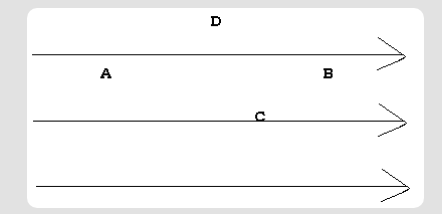
A negative charge is located in the uniform electric field between two plates $($not shown$).$
Where in the diagram will the electron have the greatest change in potential energy before hitting the one of the plates?
A charge $q$ is placed at the centre of the line joining two equal charges $Q$. The system of the three charges will be in equilibrium, if $q$ is equal to
A simple pendulum of period T has a metal bob which is negatively charged. If it is allowed to oscillate above a positively charged metal plate, its period will 
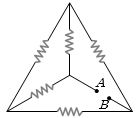
In the network shown in the figure, each of the resistance is equal to $2\,\Omega $. The resistance between the points $A$ and $B$ is .............. $\Omega$
The minimum intensity of light to be detected by human eye is ${10^{ - 10}}W/{m^2}$. The number of photons of wavelength $5.6 \times {10^{ - 7}}m$ entering the eye, with pupil area ${10^{ - 6}}{m^2}$, per second for vision will be nearly
The rest mass of the photon is
The $\mu_0$ is also known as :
A parallel plate capacitor has a plate separation of $0.01\, mm$ and use a dielectric (whose dielectric strength is $19\, KV/mm$) as an insulator. The maximum potential difference that can be applied to the terminals of the capacitor is......$V$
An electromagnetic wave in vacuum has the electric and magnetic field $\vec E$ and $\vec B$ , which are always perpendicular to each other. The direction of polarization is given by $\vec X$ and that of wave propagation by $\vec k$ . Then
An air bubble in a glass slab with refractive index $1.5$ (near normal incidence) is $5\,\, cm$ deep when viewed from one surface and $3\,\, cm$ deep when viewed from the opposite face. The thickness (in $cm$) of the slab is