Question
The magnetic susceptibility is negative for

Answer

(b) The magnetic susceptibility indicates whether a material is repelled out or attracted of a magnetic field. It is negative only for diamagnetic material. It is positive for paramagnetic material and ferromagnetic material has large positive magnetic susceptibility

Need a full question paper?

Generate a complete, print-ready paper with questions like this in minutes — across 16+ boards, with answer keys.
Start Generating Free

Similar questions

A charged particle of mass $m$ and charge $q$ describes circular motion of radius $r$ in a uniform magnetic field of strength $B$. The frequency of revolution is
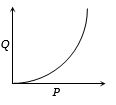
The graph shows the behaviour of a length of wire in the region for which the substance obeys Hook’s law. $P$ and $Q$ represent
For a thermodynamic process $\delta Q = -50$ $calorie$ and $W = -20$ $calorie$ . If the initial internal energy is $-30$ $calorie$ then final internal energy will be ....... $calorie$
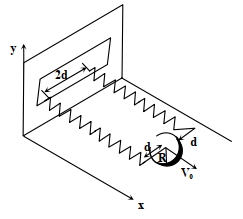
A uniform thin cylindrical disk of mass $\mathrm{M}$ and radius $\mathrm{R}$ is attached to two identical massless springs of spring constant $\mathrm{k}$ which are fixed to the wall as shown in the figure. The springs are attached to the axle of the disk symmetrically on either side at a distance $\mathrm{d}$ from its centre. The axle is massless and both the springs and the axle are in horizontal plane. The unstretched length of each spring is $L$. The disk is initially at its equilibrium position with its centre of mass $(CM)$ at a distance $L$ from the wall. The disk rolls without slipping with velocity $\overrightarrow{\mathrm{V}}_0=\mathrm{V}_0 \hat{\mathrm{i}}$. The coefficient of friction is $\mu$. Figure:$Image$

$1.$ The net external force acting on the disk when its centre of mass is at displacement $\mathrm{x}$ with respect to its equilibrium position is

$(A)$ $-\mathrm{kx}$ $(B)$ $-2 k x$ $(C)$ $-\frac{2 \mathrm{kx}}{3}$ $(D)$ $-\frac{4 k x}{3}$

$2.$ The centre of mass of the disk undergoes simple harmonic motion with angular frequency $\omega$ equal to

$(A)$ $\sqrt{\frac{k}{M}}$ $(B)$ $\sqrt{\frac{2 \mathrm{k}}{\mathrm{M}}}$ $(C)$ $\sqrt{\frac{2 \mathrm{k}}{3 \mathrm{M}}}$ $(D)$ $\sqrt{\frac{4 \mathrm{k}}{3 \mathrm{M}}}$

$3.$ The maximum value of $\mathrm{V}_0$ for which the disk will roll without slipping is

$(A)$ $\mu g \sqrt{\frac{\mathrm{M}}{\mathrm{k}}}$ $(B)$ $\mu g \sqrt{\frac{M}{2 k}}$ $(C)$ $\mu g \sqrt{\frac{3 M}{k}}$ $(D)$ $\mu g \sqrt{\frac{5 \mathrm{M}}{2 \mathrm{k}}}$

Give the answer question $1,2$ and $3.$
A sealed container with negligible coefficient of volumetric expansion contains helium (a monoatomic gas). When it is heated from $300\, K$ to $600\, K,$ the average $K.E.$ of helium atoms is
A Galileo telescope has an objective of focal length $100 \,cm $ and magnifying power $50$. The distance between the two lenses in normal adjustment will be....$cm$
A satellite is moving with a constant speed ' $V$ ' in a circular orbit about the earth. An object of mass ' $m$ ' is ejected from the satellite such that it just escapes from the gravitational pull of the earth. At the time of its ejection, the kinetic energy of the object is
The mass of a particle is $1\,\,kg$ and it is moving along  $x-$ axis. The period of its small oscillation is $\frac {\pi }{2}$ . Its potential energy may be
An electron is moving along the positive $x$-axis. If the uniform magnetic field is applied parallel to the negative $z$-axis. then

$A.$ The electron will experience magnetic force along positive $y$-axis

$B.$ The electron will experience magnetic force along negative $y$-axis

$C.$ The electron will not experience any force in magnetic field

$D.$ The electron will continue to move along the positive $x$-axis

$E.$ The electron will move along circular path in magnetic field

Choose the correct answer from the options given below:

The specific heat capacity of a metal at low temperature $(T)$ is given as $C_p=32\left(\frac{ T }{400}\right)^{3}\;kJ\,k ^{-1}\, kg ^{-1}$. A $100\; g$ vessel of this metal is to be cooled from $20 \;K$ to $4\; K$ by a special refrigerator operating at room temperature $27^\circ c$). The amount of work required to cool the vessel is