Question
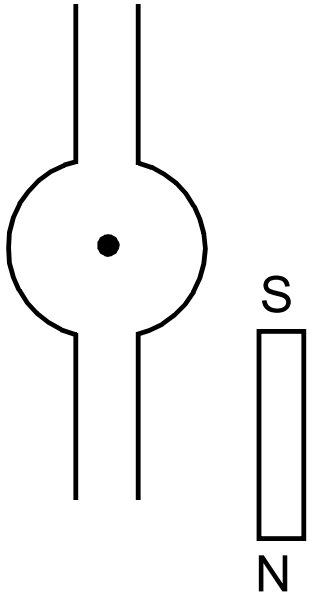
The magnetometer of the previous problem is used with the same magnet in $\tan-\text{B}$ position. Where should the magnet be placed to produce a 37° deflection of the needle?
Answer

Given $\frac{\text{M}}{\text{B}_\text{H}}=40\text{A-m}^2/\text{T}$
Since the magnet is short ‘ℓ’ can be neglected
So, $\frac{\text{M}}{\text{B}_\text{H}}=\frac{4\pi}{\mu_0}\times\frac{\text{d}^3}{2}=40$
$\Rightarrow\text{d}^3=\frac{40\times4\pi\times10^{-7}\times2}{4\pi}=8\times10^{-6}$
$\Rightarrow\text{d}=2\times10^{-2}\text{m}=2\text{cm}$
with the northpole pointing towards south.

Need a full question paper?

Generate a complete, print-ready paper with questions like this in minutes — across 16+ boards, with answer keys.

Start Generating Free

Similar questions

For the $L - C - R$ series $AC$ circuit derive the phase relationship between instantaneous current and voltage, using the phasor diagram.
In the study of Geiger-Marsdon experiment on scattering of α particles by a thin foil of gold, draw the trajectory ofα−particles in the Coulomb field of target nucleus. Explain briefly how one gets the information on the size of the nucleus from this study. From the relation $R = R_0\ A^{1/3},$ where $R_0$ is constant and A is the mass number of the nucleus, show that nuclear matter density is independent of A.
A van is standing on a frictionless portion of a horizontal road. To start the engine, the vehicle must be set in motion in the forward direction. How can the persons sitting inside the van do it without coming out and pushing from behind?
Draw a graph showing the change in potential corresponding to the change in distance from a point charge. For the charged system shown in the figure, prove that the potential difference between points $A$ and $B$ is
Image
(a) An electron is revolving with a speed of 2 $\times 10^5 m / s$ in the orbit of radius $0.51 A$ in a hydrogen atom. Calculate the magnetic moment of the electron.
(b) Equivalent electric current due to orbital speed of electron.
(c) Magnetic field generated at the centre of the nucleus.
In motor vehicles, a convex mirror is attached near the driver's seat to give him the view of the traffic behind. What is the special function of this convex mirror which a plane mirror can not do?
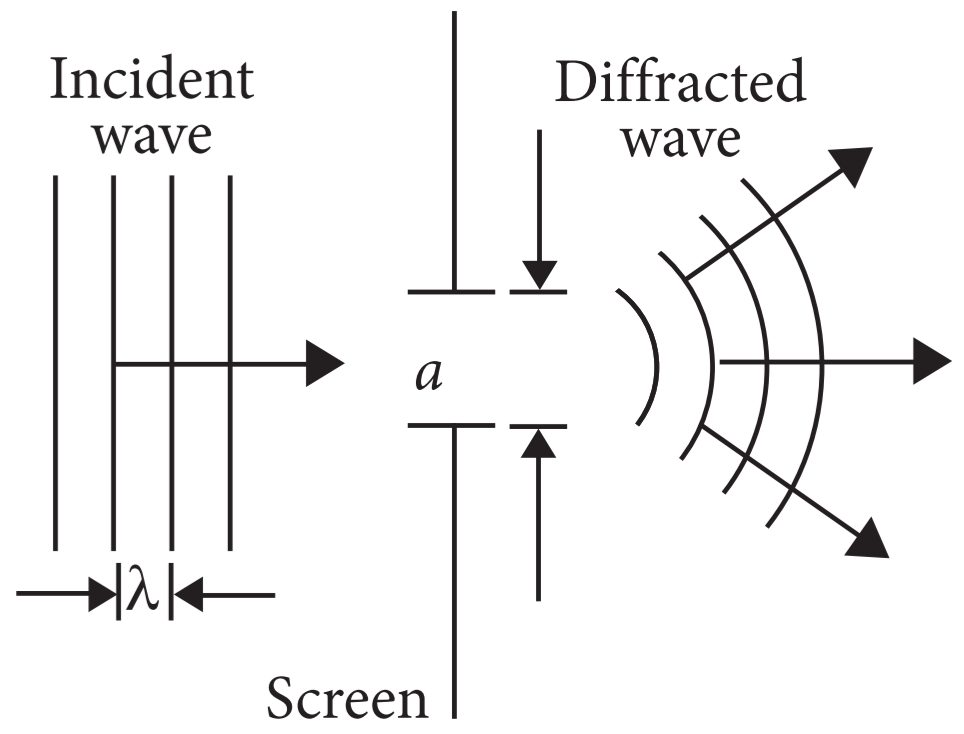
The phenomenon of bending ofli ght around the sharp corners and the spreading of light within the geometrical shadow of the opaque obstacles is called diffraction of light. The light thus deviates from its linear path. The deviation becomes much more pronounced, when the dimensions of the aperture or the obstacle are comparable to the wavelength of light.
  1. Light seems to propagate in rectilinear path because.
  1. Its spread is very large.
  2. Its wavelength is very small.
  3. Reflected from the upper surface of atmosphere.
  4. It is not absorbed by atmosphere.
  1. ln diffraction from a single slit the angular width of the central maxima does not depends on:
  1. $\lambda$ of light used.
  2. Width of slit.
  3. Distance of slits from the screen.
  4. Ratio of $\lambda$ and slit width.
  1. For a diffraction from a single slit, the intensity of the central point is:
  1. Infinite.
  2. Finite and same magnitude as the surrounding maxima.
  3. Finite but much larger than the surrounding maxima.
  4. Finite and substantially smaller than the surrounding maxima.
  1. Resolving power of telescope increases when:
  1. Wavelength of light decreases.
  2. Wavelength of light increases.
  3. Focal length of eye-piece increases.
  4. Focal length of eye-piece decreases.
  1. ln a single diffraction pattern observed on a screen placed at D metre di stance from the slit of width d metre, the ratio of the width of the central maxima to the width of other secondary maxima is:
  1. 2 : 1
  2. 1 : 2
  3. 1 : 1
  4. 3 : 1
The lens maker's formula relates the focallength of a lens to the refractive index of the lens material and the radii of curvature of its two surfaces. This formula is called so because it is used by manufacturers to design lenses of required focal length from a glass of given refractive index.
If the object is placed at infinity, the image will be fanned at focus for both double convex lens and double concave lens.
Therefore, lens maker's formula is, $\frac{1}{\text{f}}=[\frac{\mu_2-\mu_1}{\mu_1}][\frac{1}{\text{R}_1}-\frac{1}{\text{R}_2}]$
When lens is placed in air, $\mu_1=1$ and $\mu_2=\mu.$ The lens maker formula takes the form, $\frac{1}{\text{f}}=(\mu-1)[\frac{1}{\text{R}_1}-\frac{1}{\text{R}_2}]$
  1. The radius of curvature of each face of biconcave lens with refractive index 1.5 is 30cm. The focal length of the lens in air is:
  1. 12cm
  2. 10cm
  3. 20cm
  4. 30cm
  1. The radii of curvature of the faces of a double convex lens are 10cm and 15cm. If focal length is 12cm, then refractive index of glass is:
  1. 1.5
  2. 1.78
  3. 2.0
  4. 2.52
  1. An under-water swinuner cannot see very clearly even in absolutely clear water because of:
  1. Absorption of light in water.
  2. Scattering of light in water.
  3. Reduction of speed of light in water.
  4. Change in the focal length of eye-lens.
  1. A thin lens of glass $(\mu=1.5)$ of focal length 10cm is immersed in water $(\mu=1.33).$ The new focal length is:
  1. 20cm
  2. 40cm
  3. 48cm
  4. 12cm
  1. An object is immersed in a fluid. In order that the object becomes invisible, it should,
  1. Behave as a perfect reflector.
  2. Absorb all light falling on it.
  3. I have refractive index one.
  4. Have refractive index exactly matching with that of the surrounding fluid.
When the atomic dipoles are aligned partially or fully, there is a net magnetic moment in the direction of the field in any small volume of the material. The actual magnetic field inside material placed in magnetic field is the sum of the applied magnetic field and the magnetic field due to magnetisation. This field is called magnetic intensity (H).
$\text{H}=\frac{\text{B}}{\mu_0}-\text{M}$
where Mis the magnetisation of the material, flo is the permittivity of vacuum and B is the total magnetic field. The measure that tells us how a magnetic material responds to an external field is given by a dimensionless quantity is appropriately called the magnetic susceptibility: for a certain class of magnetic materials, intensity of magnetisation is directly proportional to the magnetic intensity.
  1. Magnetization of a sample is:
  1. Volume of sample per unit magnetic moment.
  2. Net magnetic moment per unit volume.
  3. Ratio of magnetic moment and pole strength.
  4. Ratio of pole strength to magnetic moment.
  1. Identify the wrongly matched quantity and unit pair.
  1. Pole strength - Am
  2. Magnetic susceptibility - dimensionless number
  3. Intensity of magnetisation $ - Am^{-1}$
  4. Magnetic permeability - Henry m
  1. A closed surface S encloses a magnetic dipole of magnetic moment 2ml. The magnetic flux emerging from the surface is:
  1. $2 \times 10^5A/ m$
  2. $3 \times 10^5A/ m$
  3. $4 \times 10^5A/ m$
  4. $5 \times 10^5A/ m$
  1. A solenoid has core of a material with relative permeability 500 and its windings carry a current of 1A. The number of turns of the solenoid is 500 per metre. The magnetization of the material is nearly,
  1. $2.5 \times 10^3Am^{-1}$
  2. $2.5 \times 10^5Am^{-1}$
  3. $2.0 \times 10^3Am^{-1}$
  4. $2.0 \times 10^5Am^{-1}$
  1. The relative penneability of iron is 6000. Its magnetic susceptibility is:
  1. $5999$
  2. $6001$
  3. $6000 \times 10^{-7}$
  4. $6000 \times 10^7$
Find the acceleration due to gravity of the moon at a point 1000km above the moon's surface. The mass of the moon is $7.4 \times 10^{22}kg$ and its radius is 1740km.