MCQ
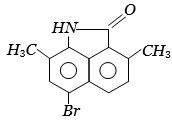
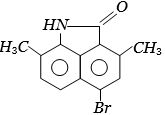
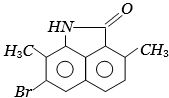
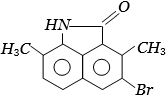
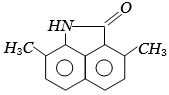
The major product obtained when $B{r_2}/Fe$ is treated with is
  • B

  • C

  • D

Answer

Correct option: A.

a
(a) The phenyl ring having $H -N<$ group is activated while another one is deactivated due to $ - \mathop {\mathop C\limits_{||} }\limits_O - $, so electrophilic aromatic bromination will occur at para position with respect to $H -N<$ group inactivated ring.

Need a full question paper?

Generate a complete, print-ready paper with questions like this in minutes — across 16+ boards, with answer keys.

Start Generating Free

Similar questions

On heating a mixture of $SO_2Cl_2$ and $CO$ two equilibria are simultaneously established

$S{O_2}C{l_2}\left( g \right) \rightleftharpoons S{O_2}\left( g \right) + C{l_2}\left( g \right)$

$CO\left( g \right) + C{l_2}\left( g \right) \rightleftharpoons COC{l_2}\left( g \right)$

on adding more $SO_2$ at equilibrium what will happen?

At $298\, K$ find out the $emf$ for the cell ................ $\mathrm{V}$

$A{l_{\left( s \right)}}|A{l^{ + 3}}\left( {0.1\,M} \right)||F{e^{ + 2}}\left( {0.001\,M} \right)|Fe\left( s \right)$ If $E_{A{l^{ + 3}}/Al}^o =  - 1.66\,V$ and $E_{Fe/F{e^{ + 2}}}^o =  + 0.44\,V$

What is the expected order of reactivity of the following compounds in  electrophilic chlorination $(Cl_2 + FeCl_3)$?
(more reactive $>$ less reactive)
Number of electrons in the valence orbit of nitrogen in an ammonia molecule are
Given below are two statements:

Statement $I$ : The decrease in first ionization enthalpy from $B$ to $Al$ is much larger than that from $Al$ to $Ga$.

Statement $II$ : The d orbitals in Ga are completely filled.

In the light of the above statements, choose the most appropriate answer from the options given below

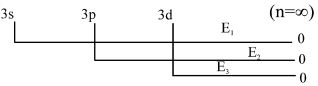
For $H-$atom, the energy required for the removal of electron from various sub-shells is given as under :

The order of the energies would be :

Anhydrous $AlC{l_3}$ cannot be obtained from which of the following reactions
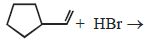
Which of the following product is not formed in the following reaction
In a solution of acid ${H^ + }$ concentration is ${10^{ - 10}}M.$ The $pH$ of this solution will be
$B(OH)_3 + NaOH  \rightleftharpoons  NaBO_2 + Na [B(OH)_4] +H_2O$

How can this reaction is made to proceed in forward direction?