Question
The mass defect per nucleon is called
|
(a) Binding energy |
(b) Packing fraction |
(c) Ionisation energy |
(d) Excitation energy |
The mass defect per nucleon is called
|
(a) Binding energy |
(b) Packing fraction |
(c) Ionisation energy |
(d) Excitation energy |
(b) Packing fraction
Generate a complete, print-ready paper with questions like this in minutes — across 16+ boards, with answer keys.
Which of the following is not the unit of self inductance
|
(a) Weber/Ampere |
(b) Ohm-Second |
(c) Joule-Ampere |
(d) Joule Ampere–2 |
Critical angle is that angle of incidence in the denser medium for which the angle of refraction in rarer medium is
|
(a) 0° |
(b) 57° |
(c) 90° | (d) 180° |
The energy of a charged capacitor is given by the expression (q = charge on the conductor and C = its capacity)
|
(a) |
(b) |
(c) 2qC |
(d) |
A metallic ring connected to a rod oscillates freely like a pendulum. If now a magnetic field is applied in horizontal direction so that the pendulum now swings through the field, the pendulum will
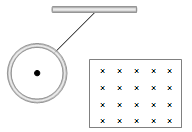
|
(a) Keep oscillating with the old time period |
|
(b) Keep oscillating with a smaller time period |
|
(c) Keep oscillating with a larger time period |
|
(d) Come to rest very soon |
A current of 5 ampere is flowing in a wire of length 1.5 metres. A force of 7.5 N acts on it when it is placed in a uniform magnetic field of 2 Tesla. The angle between the magnetic field and the direction of the current is
|
(a) 30° |
(b) 45° |
(c) 60° |
(d) 90° |
A closely wound coil of 100 turns and area of cross-section  has a coefficient of self-induction 1 mH. The magnetic induction in the centre of the core of the coil when a current of 2A flows in it, will be
|
(a) |
(b) |
(c) |
(d) |
Four capacitors of each of capacity 3μF are connected as shown in the adjoining figure. The ratio of equivalent capacitance between A and B and between A and C will be

|
(a) 4 : 3 |
(b) 3 : 4 |
(c) 2 : 3 |
(d) 3 : 2 |
$\lambda\geq\lambda_0$
$\lambda\geq2\lambda_0$
$\lambda\leq\lambda_0$
$\lambda<\frac{\lambda_ 0}{2}.$


