MCQ
The mass defect per nucleon is called:
  • A
    Binding energy
  • Packing fraction
  • C
    Ionisation energy
  • D
    Excitation energy

Answer

Correct option: B.
Packing fraction

Nuclear binding energy can be computed from the difference in mass of a nucleus, and the sum of the masses of the number of free neutrons and protons that make up the nucleus. Once this mass difference, called the mass defect or mass deficiency, is known, Einstein's mass$-$energy equivalence formula can be used to compute the binding energy of any nucleus.
Early nuclear physicists used to refer to computing this value as a "packing fraction" calculation.

Need a full question paper?

Generate a complete, print-ready paper with questions like this in minutes — across 16+ boards, with answer keys.
Start Generating Free

Similar questions

Light of frequency n is incident on a certain photoelectric substance with threshold frequency $\mathrm{n}_0$. The work function for the substance is
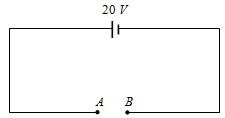
In the shown circuit, what is the potential difference across A and B

The coefficient of self inductance of a solenoid is 0.18 mH. If a crode of soft iron of relative permeability 900 is inserted, then the coefficient of self inductance will become nearly
The mass of an atomic nucleus is less than the sum of the masses of its constituents. This mass defect is converted into?
A coil of area 80 square cm and 50 turns is rotating with 2000 revolutions per minute about an axis perpendicular to a magnetic field of 0.05 Tesla. The maximum value of the e.m.f. developed in it is
A parallel plate capacitor Air filled with a dielectric whose dielectric constant varies with applied voltage as $K = V$. An identical capacitor $B$ of capacitance $C_0$ with air as dielectric is connected to voltage source $V_0 = 30\,V$ and then connected to the first capacitor after disconnecting the voltage source. The charge and voltage on capacitor.
A magnetic needle suspended horizontally by an unspun silk fibre, oscillates in the horizontal plane because of the restoring force originating mainly from
Which of the following is deflected by electric field
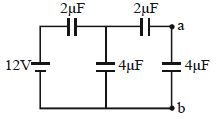
Find the potential difference $V_a -V_b$ between the points $a$ and $b$ shown in each  part of the figure.
Statement $-1$ : Path of the charge particle may be straight line in uniform magnetic field.
Statement $-2$ : Path of the charge particle is decided by the angle between its velocity and the magnetic force working on it