MCQ
The mass number of a nucleus is equal to:
- AThe number of neutrons in the nucleus.
- BThe number of protons in the nucleus.
- CThe number of nucleons in the nucleus.
- DNone of them.
Explanation:
Mass number of a nucleus is defined as the sum of the number of neutron and protons present in the nucleus, i.e. the number of nucleons in the nucleus.
Generate a complete, print-ready paper with questions like this in minutes — across 16+ boards, with answer keys.
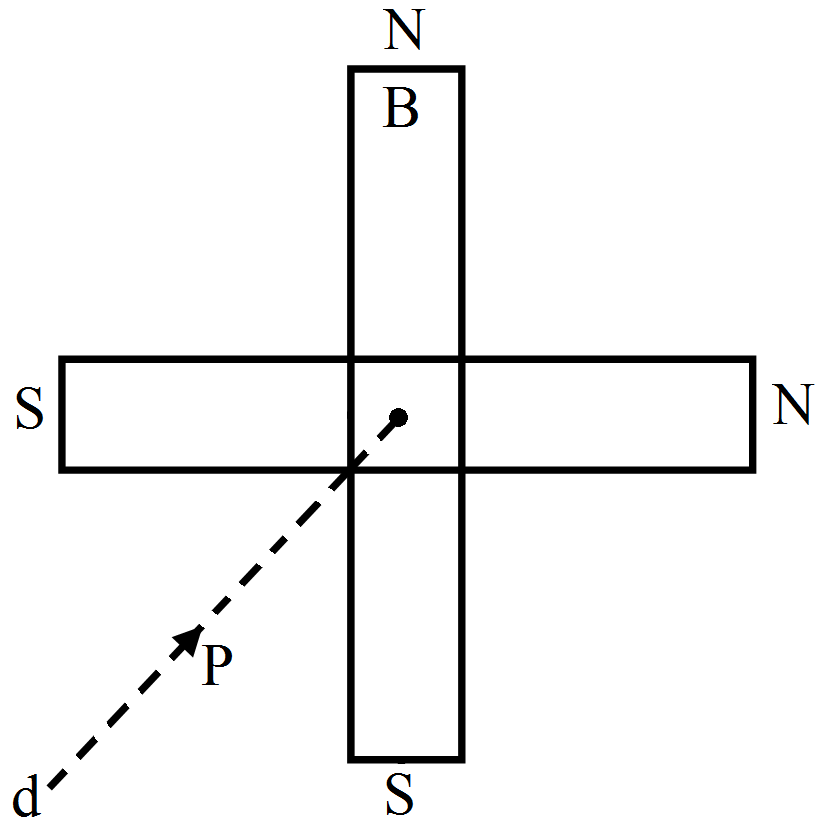
$\frac{\mu_0}{4\pi}\frac{2\text{M}}{\text{d}^3}$
Two bulbs of 100 W and 200 W working at 220 volt are joined in series with 220 volt supply. Total power consumed will be approximately.
|
(a) 65 watt |
(b) 33 watt |
(c) 300 watt |
(d) 100 watt |
A cell is connected between two points of a uniformly thick circular conductor. The magnetic field at the centre of the loop will be (Here  and
and  are the currents flowing in the two parts of the circular conductor of radius ‘a’ and
  has the usual meaning)
|
(a) Zero |
(b) |
(c) |
(d) |
The plates of a parallel plate condenser are pulled apart with a velocity v. If at any instant their mutual distance of separation is d, then the magnitude of the time of rate of change of capacity depends on d as follows
|
(a) |
(b) |
(c) |
(d) d |
A straight wire carrying current i is turned into a circular loop. If the magnitude of magnetic moment associated with it in M.K.S. unit is M, the length of wire will be
|
(a) 4πiM |
(b) |
(c) |
(d) |


