Question
The material suitable for making electromagnets should have:

Answer

  1. High retentivity and low coercivity.
Explanation:
An electromagnet is necessary for the material that even if the current is turned off, the material losses its magnetic field. So, it should be made from such a material that its retentivity is very high. And there must be enough coercion force for the material which can restore its pre-magnetization state. For that its coercivity should be as minimum as possible.

Need a full question paper?

Generate a complete, print-ready paper with questions like this in minutes — across 16+ boards, with answer keys.
Start Generating Free

Similar questions

Two voltameters, one of copper and another of silver, are joined in parallel. When a total charge $q$ flows through the voltameters, equal amount of metals are deposited. If the electrochemical equivalents of copper and silver are $\mathrm{z}_1$ and $\mathrm{z}_2$ respectively the charge which flows through the silver voltameter is
According to Einstein's interpretation of the photoelectric effect, the maximum $K.E$. of photoelectrons depends on $( h -W)$ where is the frequency of incident radiation and $W$ is the work function. For three different metals graph plotted between maximum $K/E$. and the frequency of incident radiations. The three graphs obtained: 
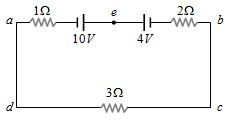
The magnitude and direction of the current in the circuit shown will be
The filament of an electric bulb is made of:
An image of the sun is formed by a lens of focal length of $30 \ cm$ on the metal surface of a photoelectric cell and a photoelectric current $I$ is produced. The lens forming the image is then replaced by another of the same diameter but of focal length $15 \ cm.$ The photoelectric current in this case is
The slits in a Young's double slit experiment have equal widths and the source is placed symmetrically relative to the slits. The intensity at the central fringes is $\mathrm{I}_0.$ If one of the slits is closed, the intensity at this point will be
The human eye has a lens which has a(a) Soft portion at its centre(b) Hard surface(c) Varying refractive index(d) Constant refractive index
   
   
The length of side of a square coil is 50cm and number of turns in it is 100. If it is placed at right angles to a magnetic field which is changing at the rate of 4 Tesla/ s, then induced emf in the coil will be:
If an electron oscillates at a frequency of 1 GHz it gives(a) X-rays (b) Mirowaves (c) Infrared rays (d) None of these
       
A 220V main supply is connected to a resistance of $100\text{k}\Omega$ The effective current is?