MCQ
The material which practically does not show elastic after effect is
  • A
    Copper
  • B
    Rubber
  • C
    Steel
  • Quartz

Answer

Correct option: D.
Quartz
d
(d) Quartz is the substance which shows practically no$-$elastic after effect.

Need a full question paper?

Generate a complete, print-ready paper with questions like this in minutes — across 16+ boards, with answer keys.

Start Generating Free

Similar questions

The velocity at the maximum height of a projectile is $\frac{\sqrt{3}}{2}$ times its initial velocity of projection $(u)$. Its range on the horizontal plane is .............
A quantity $x$ is given by $\left( IF v^{2} / WL ^{4}\right)$ in terms of moment of inertia $I,$ force $F$, velocity $v$, work $W$ and Length $L$. The dimensional formula for $x$ is same as that of
A body, constrained to move in the $Y-$direction is subjected to a force given by $\overrightarrow F = ( - 2\hat i + 15\hat j + 6\hat k)\,N.$ What is the work done by this force in moving the body a distance $10\,  m$ along the $Y-$axis ...... $J$
The equations of two waves are given by

$y_{1}=5 \sin 2 \pi(x-v t) \,c m\,$

$y_{2}=3 \sin 2 \pi(x-v t+1.5) \,c m$

These waves are simultaneously passing through a string. The amplitude of the resulting wave is.........$cm$
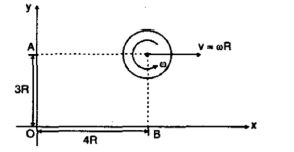
A disc of mass $M$ and radius $R$ moves in the $x-y$ plane as shown in the figure. The angular momentum of the disc at the instant shown is
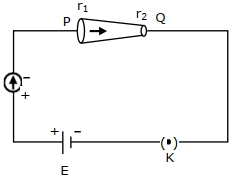
In the given figure, a battery of emf $E$ is connnected across a conductor $P Q$ of length $'Y'$ and different area of cross-sections having radii $r_{1}$ and $r_{2}\left(r_{2}\,<\,r_{1}\right)$.

Choose the correct option as one moves from $P$ to $Q$ :
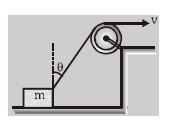
A block is dragged on a smooth plane with the help of a rope which moves with a velocity $v$ as shown in figure. The horizontal velocity of the block is
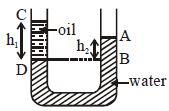
In a $U-$ tube experiment, a column $AB$ of water is balanced by a column $‘CD’$ of oil, as shown in the figure. Then the relative density of oil is
A spherical soap bubble has in ternal pressure $P_0$ and radius $r_0$ and is in equilibrium in an enclosure with pressure ${P_1} = \frac{{8{P_0}}}{9}$ . The enclosure is gradually evacuated . Assuming temperature and surface tension of soap bubble to be fixed find the value of $\frac{{{\rm{final\,\, radius}}}}{{{\rm{initial\,\, radius}}}}$ of soap bubble
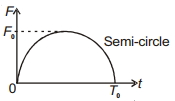
The magnitude of force acting on a particle moving along $x$-axis varies with time $(t)$ as shown in figure. If at $t=0$ the velocity of particle is $v_0$, then its velocity at $t=T_0$ will be