MCQ
The materials suitable for making electromagnets should have
  • A
    High retentivity and high coercivity
  • B
    High retentivity and low coercivity
  • Low retentivity and low coercivity
  • D
    Low retentivity and high coercivity

Answer

Correct option: C.
Low retentivity and low coercivity
c
Electro magnet should be amenable to magnetisation and demagnetization Retenivity should be low and coercivity should be low

Need a full question paper?

Generate a complete, print-ready paper with questions like this in minutes — across 16+ boards, with answer keys.
Start Generating Free

Similar questions

An electron and a proton are at a distance of $1\,{\mathop A\limits^o }$. The moment of this dipole will be $(C × m)$
The ratio of peak value and r.m.s value of an alternating current is
Two wires $A$ and $B $ of same material and same mass have radius $2r$ and $r$ . If resistance of wire $A$ is $34\,\Omega $, then resistance of $B$ will be ............ $\Omega$
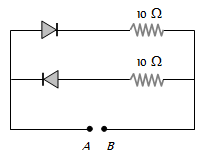
A 2V battery is connected across the points A and B as shown in the figure given below. Assuming that the resistance of each diode is zero in forward bias and infinity in reverse bias, the current supplied by the battery when its positive terminal is connected to A is
A zone plate of focal length 60 cm, behaves as a convex lens, If wavelength of incident light is $6000A^o$, then radius of first half period zone will be
When a radioactive substance is kept in a vessel, the atmosphere around it is rich with:
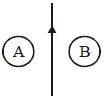
$A$ and $B$ are two metallic rings placed at opposite sides of an infinitely long straight  conducting wire as shown. If current in the wire is slowly decreased, the direction of  induced current will be :
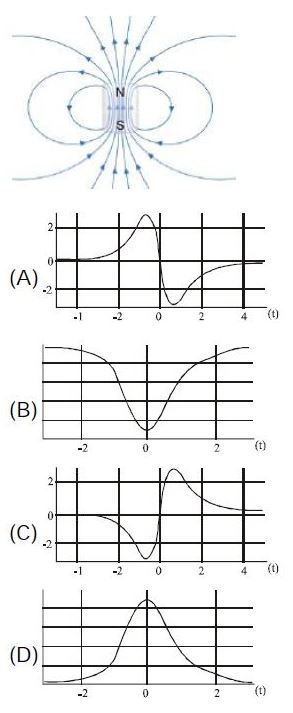
The diagram shows magnetic field lines. We move from above to below and back.Below shows the graph of variaton of magnetic flux with time. We will measure the flux of
Assume that the nuclear binding energy per nucleon $(B/A)$ versus mass number $(A)$ is as shown in the figure. Use this plot to choose the correct choice $(s)$ given below

$(A)$ Fusion of two nuclei with mass numbers lying in the range of $1 < A < 50$ will release energy

$(B)$ Fusion of two nuclei with mass numbers lying in the range of $51 < A < 100$ will release energy

$(C)$ Fission of a nucleus lying in the mass range of $100 < A < 200$ will release energy when broken into two equal fragments

$(D)$ Fission of a nucleus lying in the mass range of $200 < A < 260$ will release energy when broken into two equal fragments

The value of $1$ amu is equal to: