Question
The maximum current that flows through a fuse wire before it blows out varies with its radius as
|
(a) |
(b) r |
(c) |
(d) |
The maximum current that flows through a fuse wire before it blows out varies with its radius as
|
(a) |
(b) r |
(c) |
(d) |
(a) 
Generate a complete, print-ready paper with questions like this in minutes — across 16+ boards, with answer keys.
Ratio of amplitude of interfering waves is 3 : 4. Now ratio of their intensities will be
|
(a) |
(b) 49 : 1 |
(c) |
(d) None of these |
Find the power of the circuit
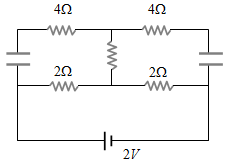
|
(a) 1.5 W |
(b) 2 W |
(c) 1 W |
(d) None of these |
Minimum energy required to takeout the only one electron from ground state of  is
is
|
(a) 13.6 eV |
(b) 54.4 eV |
(c) 27.2 eV |
(d) 6.8 eV |
In hydrogen atom, if the difference in the energy of the electron in n = 2 and n = 3 orbits is E, the ionization energy of hydrogen atom is
|
(a) 13.2 E |
(b) 7.2 E |
(c) 5.6 E |
(d) 3.2 E |
Three right angled prisms of refractive indices  and
and  are fixed together using an optical glue as shown in figure. If a ray passes through the prisms without suffering any deviation, then

|
(a) |
(b) |
|
(c) |
(d) 1 + |
In the circuit given E = 6.0 V, R1 = 100 ohms, R2 = R3 = 50 ohms, R4 = 75 ohms. The equivalent resistance of the circuit, in ohms, is
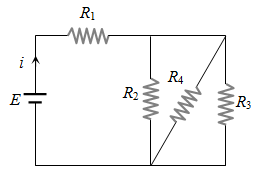
|
(a) 11.875 |
(b) 26.31 |
(c) 118.75 |
(d) None of these |


