MCQ
The maximum electric field that a dielectric medium can withstand without break$-$down is called its:
  • A
    Permittivity.
  • B
    Dielectric constant.
  • C
    Electric susceptibility.
  • Dielectric strength.

Answer

Correct option: D.
Dielectric strength.

Need a full question paper?

Generate a complete, print-ready paper with questions like this in minutes — across 16+ boards, with answer keys.
Start Generating Free

Similar questions

When $Ge$ crystals are doped with phosphorus atom, then it becomes
When a light wave goes from air into water, the quality that remains unchanged is its
A permanent magnet
Four resistances of $15\; \Omega, 12\; \Omega, 4 \;\Omega$ and $10\; \Omega$ respectively in cyclic order to form Wheats tone's network. The resistance that is to be connected in parallel with the resistance of $10\; \Omega$ to balance the network is .................. $\Omega$
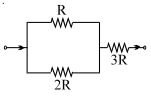
The ratio of powers dissipatted respectively in $R$ and $3R$, as shown is:
The radio of deBroglie wavelengths of a proton and an alpha particle of same energy is:
If the binding energy of the deutrium is $2.23\, MeV$. The mass defect given in $a.m.u.$ is
A nucleus with $Z = 92$  emits the following in a sequence $:\,\alpha ,\,\alpha ,\,{\beta ^ - },{\beta ^ - },\alpha ,\,\alpha ,\alpha ,\,\alpha ,{\beta ^ - },{\beta ^ - },\alpha ,{\beta ^ - },{\beta ^ - },\alpha .$The $Z$  of the resulting nucleus is
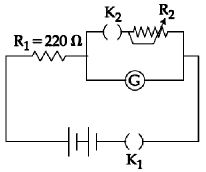
The galvanometer deflection, when key $K_1$ is closed but $K_2$ is open, equals $\theta_0$ (see figure). On closing $K_2$ also and adjusting $R_2$ to $5\,\Omega $ , the deflection in galvanometer becomes $\frac{{\theta _0}}{5}$. The resistance of the galvanometer is, then, given by [Neglect the internal resistance of battery]: .................. $\Omega$
Assertion : The resolving power of a telescope is more if the diameter of the objective lens is more.

Reason : Objective lens of large diameter collects more light.