MCQ
The maximum value of $\Big(\frac{1}{\text{x}}\Big)^\text{x}$ is:
  • A
    $\text{e}$
  • B
    $\text{e}^\text{e}$
  • C
    $\frac{1}{_\text{e}\text{e}}$
  • D
    $\Big(\frac{1}{\text{e}}\Big)^{\frac{1}{\text{e}}}$

Answer

  1. $\text{e}^{\frac{1}{\text{e}}}$

Solution:

Let $\text{y}=\Big(\frac{1}{\text{x}}\Big)^\text{x}$

$\Rightarrow\ \log\text{y}=\text{x}\cdot\log\frac{1}{\text{x}}=-\text{x}\cdot\log\text{x}$

Diffrentiating both sides w.r.t x, we get,

$\frac{1}{\text{y}}\cdot\frac{\text{dy}}{\text{dx}}=-\text{x}\cdot\frac{1}{\text{x}}-\log\text{x}$

$=-1-\log\text{x}$

$\therefore\ \frac{\text{dy}}{\text{dx}}=-\Big(\frac{1}{\text{x}}\Big)^\text{x}(1+\log\text{x})$

Now, $\frac{\text{dy}}{\text{dx}}=0$

$\Rightarrow\ 1+\log\text{x}=0$

$\Rightarrow\ \text{x}=\frac{1}{\text{e}}$

Sign scheme of f'(x) is as shown in the following figure.
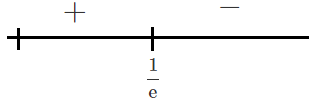
From the figure, $\text{x}=\frac{1}{\text{e}}$ is the point of maxima

Hence, maximum value of y is $\Big(\frac{1}{\frac{1}{\text{e}}}\Big)^{\frac{1}{\text{e}}}=\text{e}^{\frac{1}{\text{e}}}$

Need a full question paper?

Generate a complete, print-ready paper with questions like this in minutes — across 16+ boards, with answer keys.
Start Generating Free

Similar questions

$\int_{}^{} {{{\sin }^3}x\;.\;\cos x\;dx = } $
Based on the given shaded region as the feasible region in the graph, at which point(s) is the objective function $Z=3 x+9 y$ maximum?
Image
Function $f(x) = \frac{{{x^2} - 1}}{{{x^3} - 1}}$is not defined at $x = 1$, then the value of $f(1)$ when function is continuous at $x = 1$, will be
$\int {\frac{{1 + {{\tan }^2}x}}{{1 - {{\tan }^2}x}}\,dx} $ equals to
Let $N$ be the set of natural numbers greater than $100. $ Define the relation $R$ by : $R = \{(x,y) \in \,N × N :$ the numbers $x$ and $y$ have atleast two common divisors$\}.$ Then $R$ is-
The general solution of a differential equation of the type $\frac{\text{dx}}{\text{dy}}+\text{P}_1\text{x}=\text{Q}_1\ \text{is}$
  1. $\text{y e}^{\int\text{P}_1\text{dy}}=\int\Big(\text{Q}_1\text{e}^{\int\text{P}_1\text{dy}}\Big)\text{dy}+\text{C}$
  2. $\text{y.e}^{\int\text{P}_1\text{dx}}=\int\Big(\text{Q}_1\text{e}^{\int\text{P}_1\text{dx}}\Big)\text{dx}+\text{C}$
  3. $\text{x e}^{\int\text{P}_1\text{dy}}=\int\Big(\text{Q}_1\text{e}^{\int\text{P}_1\text{dy}}\Big)\text{dy}+\text{C}$
  4. $\text{x e}^{\int\text{P}_1\text{dx}}=\int\Big(\text{Q}_1\text{e}^{\int\text{P}_1\text{dx}}\Big)\text{dx}+\text{C}$
The point of intersection of the lines $\frac{{x + 1}}{3} = \frac{{y + 3}}{5} = \frac{{z + 5}}{7}$ and $\frac{{x - 2}}{1} = \frac{{y - 4}}{3} = \frac{{z - 6}}{5}$is
If the matrix $\left[ {\begin{array}{*{20}{c}}0&1&{ - 2}\\{ - 1}&0&3\\\lambda &{ - 3}&0\end{array}} \right]$ is singular, then $\lambda $=
Choose the correct answer from the given four options.
Corner points of the feasible region for an LPP are (0, 2), (3, 0), (6, 0), (6, 8) and (0, 5).
Let F = 4x + 6y be the objective function.
The Minimum value of F occurs at.
  1. (0, 2) only.
  2. (3, 0) only.
  3. The mid point of the line sgment joining the points (0, 2) and (3, 0) only.
  4. Any point on the line segment joining the points (0, 2) and (3, 0).
If $\left| {\,\begin{array}{*{20}{c}}1&k&3\\3&k&{ - 2}\\2&3&{ - 1}\end{array}\,} \right| = 0$,then the value of $ k $ is