MCQ
The maximum value of ${x^4}{e^{ - {x^2}}}$ is
  • A
    $e^2$
  • B
    $e^{-2}$
  • C
    $12e^{-2}$
  • $4e^{-2}$

Answer

Correct option: D.
$4e^{-2}$
d
$f(x)=x^{4} e^{-x^{2}}$ or $f^{\prime}(x)=4 x^{3} e^{-x^{2}}+x^{4} e^{-x^{2}}(-2 x)$

$2 x^{3} e^{-x^{2}}\left(2-x^{2}\right)$

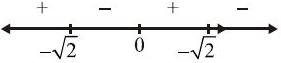
Sign scheme of $f^{\prime}(x)$ is as follows:

Hence, $f(x)$ is maximum at $x=\pm \sqrt{2}.$

Thus, maximum value $=4 \mathrm{e}^{-2}.$
Need a full question paper?

Generate a complete, print-ready paper with questions like this in minutes — across 16+ boards, with answer keys.

Start Generating Free

Similar questions

Let $f(x) = \left\{ \begin{array}{l}\frac{{{x^3} + {x^2} - 16x + 20}}{{{{(x - 2)}^2}}},{\rm{if }}\;x \ne 2\\\;\;\;\;\;\,\;\;\;\;\;\;\;k\;\;\;\;\;\;\;\;,\;{\rm{if }}\;x = 2\end{array} \right.$ If $f(x)$ be continuous for all $x$, then $ k =$
The function f : A → B defined by f(x) = -x2 + 6x- 8 is a bijection if,
  1. $\text{A}=(-\infty,3]$ and $\text{B}=(-\infty,1]$
  2. $\text{A}=[-3,\infty)$ and $\text{B}=(-\infty,1]$
  3. $\text{A}=(-\infty,3]$ and $\text{B}=[1,\infty)$
  4. $\text{A}=[3,\infty)$ and $\text{B}=[1,\infty)$
Find the values of x, if: $\begin{vmatrix} 2 &\text{amp; } 4 \\ 5 &\text{amp; } 1 \end{vmatrix}​= \begin{vmatrix} 2\text{x} &\text{amp; }4 \\ 6 &\text{amp; x} \end{vmatrix}$
  1. $\pm \sqrt{3}$
  2. $3$
  3. $-3$
  4. $\text{None of these}$
If the area bounded by $y = ax^2$ and $x = ay^2, a > 0$, is $1$ then $a =$
If $a \times (b \times c) = 0,$ then
Let $l =\mathop {Lim}\limits_{x \to \infty } \,\,\int\limits_x^{2x} {\frac{{dt}}{t}} $ and $m = \frac{1}{{x\,\ln \,x}}\,\,\int\limits_1^x {\ln \,t\,dt} $ then the correct statement is
Let the differential equation is $\left[1+\left(\frac{d y}{d x}\right)^2\right]^{\frac{3}{2}}=\frac{d^2 y}{d x^2}$. Which of the following statements is/are true?
(i) Degree of the differential equation is 2 .
(ii) Order of the differential equation is 3 .
(iii) Order and degree of differential equation respectively are 2,2 .
If for  $x \in \left( {0,\frac{1}{4}} \right)$ , the derivative of ${\tan ^{ - 1}}\left( {\frac{{6x\sqrt x }}{{1 - 9{x^3}}}} \right)$ is  $\sqrt x \cdot g\left( x \right)$ then $g\left( x \right)$ equals:
If $\text{A} = \begin{bmatrix}\cos\alpha&-\sin\alpha\\ \sin\alpha&\cos\alpha\end{bmatrix},\text{then}\ \text{A + A}'=\text{I}$, if the value of a is:
  1. $\frac{\pi}{6}$
  2. $\frac{\pi}{3}$
  3. $\text{n}$
  4. $\frac{3\pi}{2}$
Let f : R → R be given by f(x) = [x2] + [x + 1] - 3 where [x] denotes the greatest integer less than or equal to x. Then, f(x) is:
  1. Many-one and onto.
  2. Many-one and into.
  3. One-one and into.
  4. One-one and onto.