MCQ
The mechanical equivalent of heat $J$ is
  • A
    A constant
  • B
    A physical quantity
  • A conversion factor
  • D
    None of the above

Answer

Correct option: C.
A conversion factor
c
(c) $‘J’$ is a conversion

Need a full question paper?

Generate a complete, print-ready paper with questions like this in minutes — across 16+ boards, with answer keys.

Start Generating Free

Similar questions

A particle starting from the origin $(0, 0)$ moves in a straight line in the $(x, y)$ plane. Its coordinates at a later time are $(\sqrt 3 , 3) .$ The path of the particle makes with the $x-$axis an angle of ......... $^o$
When the distance travelled by a body is directly proportional to the time, the body is said to have a:
A particle moves along an arc of a circle of radius $R$ . Its velocity depends on the distance covered as $v = a\sqrt s$ , where $a$ is a constant then the angle $\alpha $ between the vector of the total acceleration and the vector of velocity as a function of $s$ will be
A circular disc of radius $R$ and thickness $\frac{R}{6}$ has moment of inertia I about an axis passing through its centre and perpendicular to its plane.  It is melted and recasted into a solid sphere.  The moment of inertia of the sphere about its diameter as axis of rotation is
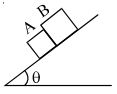
The two blocks $A$ and $B$ of equal mass are initially in contact when released from rest on the inclined plane. The coefficients of friction between the inclined plane $A$ and $B$ are $\mu_1$ and $\mu_2$ respectively.
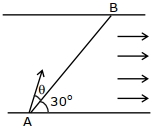
A swimmer wants to cross a river from point $A$ to point $B$. Line $A B$ makes an angle of $30^{\circ}$ with the flow of river. Magnitude of velocity of the swimmer is same as that of the river. The angle $\theta$ with the line ${AB}$ should be $^{\circ}$, so that the swimmer reaches point ${B}$.
A fan is making $600$ revolutions per minute. If after some time it makes $1200 $ revolutions per minute, then increase in its angular velocity is
A stone is dropped into a lake from a tower $500\, metre$ high. The sound of the splash will be heard by the man approximately after ..... $\sec$
The equation of a simple harmonic motion is $X = 0.34\cos (3000t + 0.74)$ where $X$ and $t$ are in $mm$ and $sec$. The frequency of motion is
The frequency at which its kinetic energy change into potential energy is