MCQ
The mechanical equivalent of heat $J$ is
  • A
    A constant
  • B
    A physical quantity
  • A conversion factor
  • D
    None of the above

Answer

Correct option: C.
A conversion factor
c
(c) $‘J’$ is a conversion

Need a full question paper?

Generate a complete, print-ready paper with questions like this in minutes — across 16+ boards, with answer keys.

Start Generating Free

Similar questions

The phase difference between two points separated by $0.8 m$ in a wave of frequency is $120 Hz$ is $\frac{\pi }{2}.$ The velocity of wave is .....  $m/s$
The order of the magnitude of speed of light in $SI$ unit is ........ 
K is a force constant of a spring. The work done in increasing its extension from l1 to l2 will be:
A car weighs  $1800\,\,kg$ . The distance between its front and back axles is  $1.8\,\,m$ . Its centre of gravity is $1.05\,\,m$  behind the front axle. Force exerted by the level ground on each front wheel is ........ $N.$
A glass flask contains some mercury at room temperature. It is found that at different temperatures the volume of air inside the flask remains the same. If the volume of mercury in the flask is $300 \,\,cm^3$, then volume of the flask is ........ $cm^3$. (given that coefficient of volume expansion of mercury and coefficient of linear expansion of glass are $1.8 × 10^{-4} (^o C)^{-1}$ and $9 × 10^{-6} (^o C)^{-1}$ respectively)
A mercury drop of $1\, cm$ radius is broken into ${10^6}$ small drops. The energy used will be (surface tension of mercury is $35 \times {10^{ - 3}}N/cm)$
Consider a spherical shell of radius $R$ at temperature $T$. The black body radiation inside it can be considered as an ideal gas of photons with internal energy per unit volume$E=$ $\frac{U}{V} \propto {T^4}$ and pressure $P = \frac{1}{3}\left( {\frac{U}{V}} \right)$ If the shell now undergoes an adiabatic expansion the relation between $T$ and $R$ is
The potential energy of a body of mass $m$ is given by $U = ax + by$, where $x$ and $y$ are the position coordinates of the particle. The acceleration of the particle is
Starting at temperature $300\; \mathrm{K},$ one mole of an ideal diatomic gas $(\gamma=1.4)$ is first compressed adiabatically from volume $\mathrm{V}_{1}$ to $\mathrm{V}_{2}=\frac{\mathrm{V}_{1}}{16} .$ It is then allowed to expand isobarically to volume $2 \mathrm{V}_{2} \cdot$ If all the processes are the quasi-static then the final temperature of the gas (in $\left. \mathrm{K}\right)$ is (to the nearest integer)
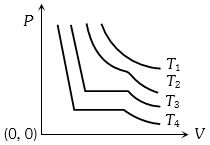
The change in volume $V$ with respect to an increase in pressure $P$ has been shown in the figure for a non-ideal gas at four different temperatures ${T_1},\,{T_2},\,{T_3}$ and ${T_4}$. The critical temperature of the gas is