The metallic bob of a simple pendulum has the relative density $\rho$. The time period of this pendulum is $T$. If the metallic bob is immersed in water, then the new time period is given by
Medium
Download our app for free and get started
(d) When the bob is immersed in water its effective weight = $\left( {mg - \frac{m}{\rho }g} \right) = mg\,\left( {\frac{{\rho - 1}}{\rho }} \right)$
$\therefore {g_{eff}} = g\,\left( {\frac{{\rho - 1}}{\rho }} \right)$
$\frac{{T'}}{T} = \sqrt {\frac{g}{{{g_{eff}}}}} $
$\frac{{T'}}{T} = \sqrt {\frac{\rho}{{\rho -1}}} $

Download our appand get started for free
Experience the future of education. Simply download our apps or reach out to us for more information. Let's shape the future of learning together!No signup needed.*
Similar Questions
- 1A simple pendulum of length $1\, m$ is oscillating with an angular frequency $10\, rad/s$. The support of the pendulum starts oscillating up and down with a small angular frequency of $1\, rad/s$ and an amplitude of $10^{-2}\, m$. The relative change in the angular frequency of the pendulum is best given byView Solution
- 2Three masses $700g, 500g$ and $400g$ are suspended at the end of a spring a shown and are in equilibrium. When the $700g$ mass is removed, the system oscillates with a period of $3\,seconds$, when the $500g$ mass is also removed, it will oscillate with a period of .... $s$View Solution

- 3A body is performing simple harmonic with an amplitude of $10 \,cm$. The velocity of the body was tripled by air Jet when it is at $5 \,cm$ from its mean position. The new amplitude of vibration is $\sqrt{ x } \,cm$. The value of $x$ is________View Solution
- 4The displacement of a particle along the $x-$ axis is given by $x=asin^2$$\omega t$ . The motion of the particle corresponds toView Solution
- 5A pendulum suspended from the ceiling of a train oscillates with a time period $2\,second$, when the train is accelerating at $10\,ms^{-2}$. What will be its time period when the train retards at $10\,ms^{-2}$ ? ..... $\sec$View Solution
- 6The instantaneous displacement of a simple pendulum oscillator is given by $x = A\cos \left( {\omega t + \frac{\pi }{4}} \right)$. Its speed will be maximum at timeView Solution
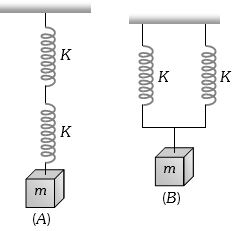
- 7Two identical spring of constant $K$ are connected in series and parallel as shown in figure. A mass $m$ is suspended from them. The ratio of their frequencies of vertical oscillations will beView Solution
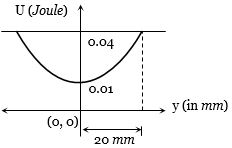
- 8View SolutionThe variation of potential energy of harmonic oscillator is as shown in figure. The spring constant is
- 9View SolutionThe total energy of a particle executing simple harmonic motion is
- 10A particle of mass $10\, gm$ is describing $S.H.M.$ along a straight line with period of $2\, sec$ and amplitude of $10, cm$. Its kinetic energy when it is at $5 \,cm$ from its equilibrium position isView Solution