Question
The minimum deviations suffered by red, yellow and violet beams passing through an equilateral transparent prism are 38.4°, 38.7° and 39.2° respectively. Calculate the dispersive power of the medium.

Answer

Given that, $\delta_\text{r}=38.4^\circ,\delta_\text{y}=38.7^\circ\ \text{and}\ \delta_\text{v}=39.2^\circ$
Dispersive power $=\frac{\mu_\text{v}-\mu_\text{r}}{\mu_\text{y}-1}=\frac{(\mu_\text{v}-1)-(\mu_\text{r}-1)}{(\mu_\text{y}-1)}$ $=\frac{\Big(\frac{\delta_\text{v}}{\text{A}}\Big)-\Big(\frac{\delta_\text{r}}{\text{A}}\Big)}{\Big(\frac{\delta_\text{v}}{\text{A}}\Big)}\ [\because\delta=(\mu-1)\text{A}]$
$=\frac{\delta_\text{v}-\delta_\text{r}}{\delta_\text{y}}=\frac{39.2-3.84^\circ}{38.7}=0.0204$

Need a full question paper?

Generate a complete, print-ready paper with questions like this in minutes — across 16+ boards, with answer keys.

Start Generating Free

Similar questions

An electron and a proton are brought nearer; how does the potential energy of system change?
Area of cross-section of a wire is $1.0 \times 10^{-7} m^2$ and the number of free electrons per cubic metre in the wire is $2 \times 10^{28}$ per $m ^3$. A current of 3.2 A is flowing in the wire. Find (i) current density in the wire (ii) drift velocity of free electrons.
A nearsighted person cannot clearly see beyond 200cm. Find the power of the lens needed to see objects at large distances.
Discuss the motion of a charged particle in a uniform magnetic field with initial velocity perpendicular to the magnetic field.
###
Explain the principle of cyclotron.
Two stable isotopes of lithium ${ }_3^6 Li$ and ${ }_3^7 Li$ have respective abundances of $75 \%$ and $92.5 \%$. These isotopes have masses $6.01512 u$ and $7.01600 u$, respectively Find the atomic mass of lithium.
The eyepiece of an astronomical telescope has a focal length of 10cm. The telescope is focused for normal vision of distant objects when the tube length is 1.0m. Find the focal length of the objective and the magnifying power of the telescope.
Light of wavelength 560nm goes through a pinhole of diameter 0.20mm and falls on a wall at a distance of 2.00m. What will be the radius of the central bright spot formed on the wall?
A plane electromagnetic wave of frequency 52 MHz travels in free space along the x -direction. At a particular point in space and time, $\overrightarrow{ E }=8.4 \hat{k} V / m$. What is $\vec{B}$ at this point ?
A copper wire of cross-sectional area 0.01cm2 is under a tension of 20N. Find the decrease in the cross-sectional area. Young's modulus of copper = 1.1 × 10 11N/m2 and Poisson's ratio = 0.32.

$\Big[$Hint: $\frac{\triangle\text{A}}{\text{A}}=2\frac{\triangle\text{r}}{\text{r}}\Big]$
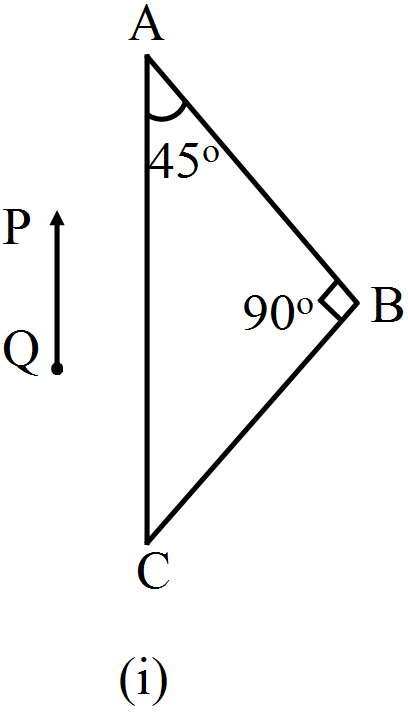
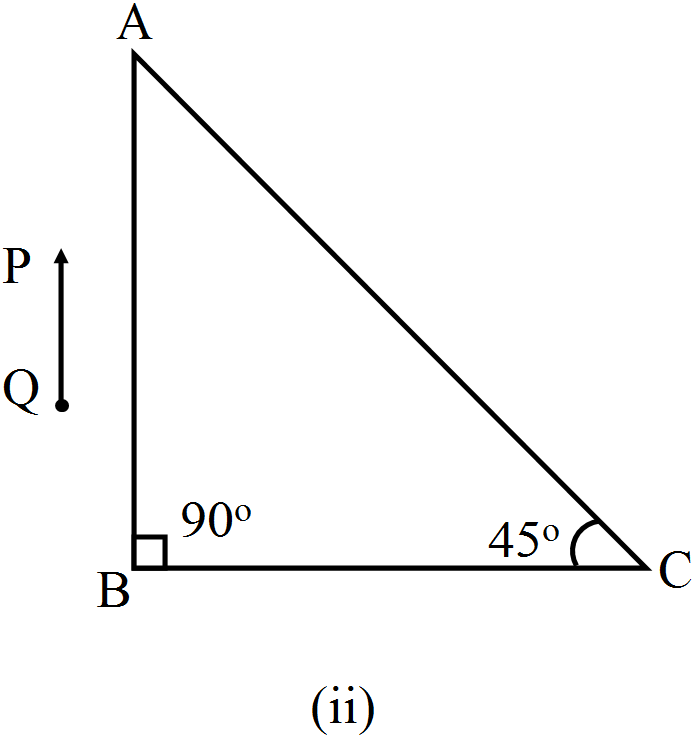
A right-angled crown glass prism with critical angle 41° is placed before an object, PQ in two positions as shown in the figures (i) and (ii). Trace the paths of the rays from P and Q passing through the prisms in the two cases.