MCQ
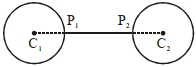
The minimum distance between any two points $P _{1}$ and $P _{2}$ while considering point $P _{1}$ on one circle and point $P _{2}$ on the other circle for the given circles' equations

$x^{2}+y^{2}-10 x-10 y+41=0$

$x^{2}+y^{2}-24 x-10 y+160=0$ is .........

  • A
    $4$
  • B
    $3$
  • C
    $2$
  • $1$

Answer

Correct option: D.
$1$
d
Given $C_{1}(5,5), r_{1}=3$ and $C_{2}(12,5), r_{2}=3$

Now, $C_{1} C_{2}>r_{1}+r_{2}$

Thus, $\left(P_{1} P_{2}\right)_{\min }=7-6=1$

Need a full question paper?

Generate a complete, print-ready paper with questions like this in minutes — across 16+ boards, with answer keys.

Start Generating Free

Similar questions

The differential equation whose solution is $(x -h)^2 + (y -k)^2 = a^2$ is ($a$ is a constant)
If $ABCD$ is a cyclic quadrilateral, then the value of $\cos A - \cos B + \cos C - \cos D = $
A particle starts at the origin and moves along the $x$-axis in such a way that its velocity at the point $(x, 0)$ is given by the formula $\frac{{dx}}{{dt}} = {\cos ^2}\pi x.$ Then the particle never reaches the point on
If $a < 0$ then the inequality $a{x^2} - 2x + 4 > 0$ has the solution represented by
Let $\Gamma$ denote a curve $y = y ( x )$ which is in the first quadrant and let the point $(1,0)$ lie on it. Let the tangent to $\Gamma$ at a point $P$ intersect the $y$-axis at $Y_p$. If $P Y_p$ has length $1$ for each point $P$ on $\Gamma$, then which of the following options is/are correct?

$(1)$ $y=\log _0\left(\frac{1+\sqrt{1-x^2}}{x}\right)-\sqrt{1-x^2}$

$(2)$ $x y^{\prime}-\sqrt{1-x^2}=0$

$(3)$ $y=-\log _0\left(\frac{1+\sqrt{1-x^2}}{x}\right)+\sqrt{1-x^2}$

$(4)$ $x y^{\prime}+\sqrt{1-x^2}=0$

Let $(\alpha, \beta, \gamma)$ be the point $(8,5,7)$ in the line $\frac{x-1}{2}=\frac{y+1}{3}=\frac{z-2}{5}$. Then $\alpha+\beta+\gamma$ is equal to
Let a relation Ron NXN be defined as:
$\left(x_1, y_1\right) R\left(x_2, y_2\right)$ if and only if $x _1 \leq x _2$ or $y _1 \leq y _2$ Consider the two statements :
(I) R is reflexive but not symmetric.
(II) R is transitive
Then which one of the following is true ?
Let $\mathrm{x}^{\mathrm{k}}+\mathrm{y}^{\mathrm{k}}=\mathrm{a}^{\mathrm{k}},(\mathrm{a}, \mathrm{K}>0)$ and $\frac{\mathrm{dy}}{\mathrm{dx}}+\left(\frac{\mathrm{y}}{\mathrm{x}}\right)^{\frac{1}{3}}=0$ then $\mathrm{k}$ is
$\frac{{\frac{1}{2}.\frac{2}{2}}}{{{1^3}}} + \frac{{\frac{2}{2}.\frac{3}{2}}}{{{1^3} + {2^3}}} + \frac{{\frac{3}{2}.\frac{4}{2}}}{{{1^3} + {2^3} + {3^3}}} + .....n$ terms =
Given the system of equation $a(x + y + z)=x,b(x + y + z) = y, c(x + y + z) = z$ where $a,b,c$  are non-zero real numbers. If the real numbers $x,y,z$ are such that $xyz \neq 0,$ then  $(a + b + c)$ is equal to-