MCQ
The minimum energy necessary to permit a reaction is
  • A
    Internal energy
  • Threshold energy
  • C
    Activation energy
  • D
    Free energy

Answer

Correct option: B.
Threshold energy
b
(b) Molecules undergoing reaction should cross over the minimum energy barrier or energy level known as threshold energy.

Need a full question paper?

Generate a complete, print-ready paper with questions like this in minutes — across 16+ boards, with answer keys.

Start Generating Free

Similar questions

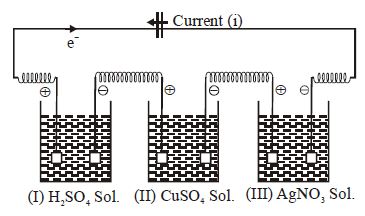
Three voltameters containing and aqueous solution of $H_2SO_4,$ $CuSO_4$ and $AgNO_3$ are connected in the following way

A current was passed for $10$ hours. $10.8\ g\ Ag$ was deposited at cathode in $(III)$ electrolytic cell during electrolysis if current efficiency is $50\%.$

What is magnitude of the current in ampere ?
The number of electrons delivered at the cathode during electrolysis by a current of $1$ ampere in $60$ seconds is (charge on electron $= 1.60 \times 10^{-19} C$)
Which of the following metal hydroxide is not soluble in excess of $NH_3$ solution ?
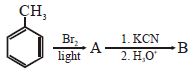
What is the final product $(B)$ of this sequence
$NaF$ is highest melting halide because it is most ionic in nature because the chosen halide has
The aldehyde which react with $NaOH$ to produce an alcohol and sodium salt is
The end product in the following sequence of reaction is

$HC \equiv CH\mathop {\xrightarrow{{{\text{1% HgS}}{{\text{O}}_{\text{4}}}}}}\limits_{20\% {H_2}S{O_4}} A\xrightarrow{{C{H_3}MgX}}B\xrightarrow{{[O]}}$

At $363\,K ,$ the vapour pressure of $A$ is $21 \,kPa$ and that of $B$ is $18\, kPa$. One mole of $A$ and $2$ moles of $B$ are mixed. Assuming that this solution is ideal, the vapour pressure of the mixture is ....... $kPa$. (Round of to the Nearest Integer).
The flame colours of metal ions are due to:
Lysine, $\text{H}_{2}\text{N}-(\text{CH}_{2})_{4}-\text{CH}-\text{COOH}\\ \ \ \ \ \ \ \ \ \ \ \ \ \ \ \ \ \ \ \ \ \ \ \ \ \ \ \ \ \ \ \ |\\ \ \ \ \ \ \ \ \ \ \ \ \ \ \ \ \ \ \ \ \ \ \ \ \ \ \ \ \ \ \ \text{NH}_{2}$ is $.......$
$a. \alpha-$Amino acid.
$b.$ Basic amino acid.
$c.$ Amino acid synthesised in body.
$d. \beta-$Amino acid.