MCQ
The minimum energy required for molecules to enter into the reaction is called
  • A
    Potential energy
  • B
    Kinetic energy
  • C
    Nuclear energy
  • Activation energy

Answer

Correct option: D.
Activation energy
d
(d) The energy necessary for molecules to undergoes chemical reaction is known as Activation energy.

Need a full question paper?

Generate a complete, print-ready paper with questions like this in minutes — across 16+ boards, with answer keys.

Start Generating Free

Similar questions

Which of the following is an example of ketohexose
The vapour pressure of acetone $(CH_3COCH_3)$ at $20\,^oC$ is $185\, torr$. When $1.2\, g$ of non volatile substance was dissolved in $100\, g$ of acetone at $20\,^oC$, its vapour pressure was $183\, torr$. The molar mass $(g\, mol^{-1})$ of the substance is
When $100\,mL$ of $0.1\,M\,NaCN$ solution is titrated with $0.1\,M\,HCl$ solution the variation of $pH$ of solution with volume of $HCl$ added will be
For the following reactions

$\mathrm{CH}_{3} \mathrm{CH}_{2} \mathrm{CH}_{2} \mathrm{Br}+\mathrm{Z}^{-}$$\xrightarrow[{{\text{Sublimation}}}]{{{k_s}}} \mathrm{CH}_{3} \mathrm{CH}_{2} \mathrm{CH}_{2} \mathrm{Z}+\mathrm{Br}^{-}$

$\mathrm{CH}_{3} \mathrm{CH}_{2} \mathrm{CH}_{2} \mathrm{Br}+\mathrm{Z}^{-}$$\xrightarrow[{{\text{elimination}}}]{{{k_e}}}\mathrm{CH}_{3} \mathrm{CH}= \mathrm{CH}_{2} +\mathrm{HZ}+\mathrm{Br}^{-}$

where 

$\mathrm{Z}^{-}=\mathrm{CH}_{3} \mathrm{CH}_{2} \mathrm{O}^{-}(\mathrm{A})$ or $\begin{array}{*{20}{c}}
  {\,C{H_3}} \\ 
  {|\,\,\,\,\,} \\ 
  {C{H_3} - C - {O^ - }(B)} \\ 
  {|\,\,\,\,} \\ 
  {\,\,C{H_3}} 
\end{array}$

$\mathrm{k}_{\mathrm{s}}$ and $\mathrm{k}_{\mathrm{e}},$ are $,$ respectively, the rate constants for the substitution and elimination, and $\mu=\frac{\mathrm{k}_{\mathrm{s}}}{\mathrm{k}_{\mathrm{e}}},$ the correct options is

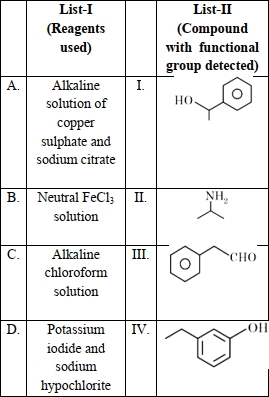
Match List$-I$ with List$-II$ :

Choose the correct answer from the options given below:
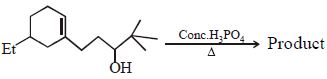
The major product of the reaction is :
$A [M(H_2O)_6]^{2+}$ complex typically absorbs at around $600\, nm$. It is  allowed to react with ammonia to form a new complex $[M(NH_3)_6]^{2+}$ that  should have absorption at ....... $nm$
$\begin{array}{*{20}{c}}
  {\begin{array}{*{20}{c}}
  {C{H_2} - OH} \\ 
  {|\,\,\,\,\,\,\,\,\,\,\,\,\,\,\,\,\,\,\,\,\,\,\,} 
\end{array}} \\ 
  {C{H_2} - OH} \\ 
  {|\,\,\,\,\,\,\,\,\,\,\,\,\,\,\,\,\,\,\,\,\,\,\,} \\ 
  {C{H_2} - SH} 
\end{array}$ ${ + \mathop {C{H_3}MgBr}\limits_{\left( {Excess} \right)}  \to xC{H_4}}$

What is the value of $x$ in the above reaction ?

Assertion : Molecular mass of benzoic acid when determined by colligative properties is found high

Reason : Dimerisation of benzoic acid.

Which transition in the hydrogen atomic spectrum will have the same wavelength as the transition, $n = 4$ to $n = 2$ of $He^+$ spectrum?