MCQ
The minimum value of $2x + 3y,$ when $xy = 6,$ is
  • $12$
  • B
    $9$
  • C
    $8$
  • D
    $6$

Answer

Correct option: A.
$12$
a
(a) $f(x) = 2x + 3y$ when $xy = 6$

$f(x) = 2x + 3y = 2x + \frac{{18}}{x}$

$f'(x) = 2 - \frac{{18}}{{{x^2}}} = 0$

==> $x = \pm 3$ and $f''(x) = \frac{{36}}{{{x^3}}} \Rightarrow f''(3) > 0$

Putting $x = + 3$, we get the minimum value to be  $12.$

Need a full question paper?

Generate a complete, print-ready paper with questions like this in minutes — across 16+ boards, with answer keys.
Start Generating Free

Similar questions

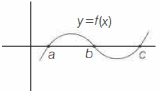
The figure shown below is the graph of the derivative of some function $y=f(x)$.Then,
Sum of co-efficients of terms of degree $m$  in the expansion of $(1 + x)^n(1 + y)^n(1 + z)^n$ is
For $0 < \phi < \frac{\pi }{2},$ if $x = \sum\limits_{n = 0}^\infty {{{\cos }^{2n}}\phi ,} $ $y = \sum\limits_{n = 0}^\infty {{{\sin }^{2n}}\phi ,} $ $z = \sum\limits_{n = 0}^\infty {{{\cos }^{2n}}\phi \,{{\sin }^{2n}}\phi ,} $ then
The remainder when $(11)^{1011}+(1011)^{11}$ is divided by $9$ is
One die has two faces marked 1 , two faces marked 2 , one face marked 3 and one face marked 4. Another die has one face marked 1 , two faces marked 2 , two faces marked 3 and one face marked 4. The probability of getting the sum of numbers to be 4 or 5 , when both the dice are thrown together, is
$\mathop {\lim }\limits_{x \to 0} \frac{{{e^{1/x}} - 1}}{{{e^{1/x}} + 1}} = $
Let $A = \left\{ {{a_1},\,{a_2},\,{a_3}.....} \right\}$ be a set containing $n$ elements. Two subsets $P$ and $Q$ of it is formed independently. The number of ways in which subsets can be formed such that $(P-Q)$ contains exactly $2$ elements, is
If $12$ identical balls are to be placed in $3$ identical boxes, then the probability that one of the boxes contains exactly $3$ balls is :
$\mathop {\lim }\limits_{x \to 0} \frac{{{y^2}}}{x} = ........$, where ${y^2} = ax + b{x^2} + c{x^3}$
If $\sin \theta  + 2\sin \phi  + 3\sin \psi  = 0$ and $\cos \theta  + 2\cos \phi  + 3\cos \psi  = 0$ , then the value of $\cos 3\theta  + 8\cos 3\phi  + 27\cos 3\psi  = $