Question
The minimum value of $\frac{{\tan \,\left( {x\,\, + \,\,{\textstyle{\pi \over 6}}} \right)}}{{\tan \,x}}$ is

Answer

d
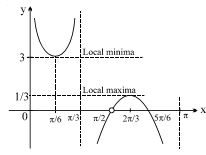
$f(x)$ has a period equal to $\pi$ & can take values $(-\infty , \infty )$ $==> 3$ is the local minimum value.

$y = \frac{{2\,\,\sin \,\,\left( {x\,\, + \,\,{\textstyle{\pi \over 6}}} \right)\,\,\cos \,x}}{{2\,\,\sin \,x\,\,\cos \,\,\left( {x\,\, + \,\,{\textstyle{\pi \over 6}}} \right)}} = \frac{{\sin \,\,\left( {2\,x\,\, + \,\,{\textstyle{\pi \over 6}}} \right)\,\, + \,\,\sin \,\,{\textstyle{\pi \over 6}}}}{{\sin \,\,\left( {2\,x\,\, + \,\,{\textstyle{\pi \over 6}}} \right)\,\, - \,\,\sin \,\,{\textstyle{\pi \over 6}}}} $

$ = 1 + \frac{1}{{\sin \,\,\left( {2\,x\,\, + \,\,{\textstyle{\pi \over 6}}} \right)\,\, - \,\,\sin \,\,{\textstyle{\pi \over 6}}}}$

$y$ is minimum if $2 x + \frac{\pi }{6} = \frac{\pi }{2}$

$==> x = \frac{\pi }{6}$                    $ ==> y_{min} = 1 + 2 = 3 $
Need a full question paper?

Generate a complete, print-ready paper with questions like this in minutes — across 16+ boards, with answer keys.

Start Generating Free

Similar questions

The arithmetic mean of the nine numbers in the given set $\{9,99,999,...., 999999999\}$ is a $9$ digit number $N$, all whose digits are distinct. The number $N$ does not contain the digit
Let a rectangle $A B C D$ of sides $2$ and $4$ be inscribed in another rectangle $P Q R S$ such that the vertices of the rectangle $A B C D$ lie on the sides of the rectangle $P Q R S$. Let $a$ and $b$ be the sides of the rectangle $P Q R S$ when its area is maximum. Then $(a+b)^2$ is equal to :
Differential coefficient of  ${\sin ^{ - 1}}x$ $w.r.t$ ${\cos ^{ - 1}}\sqrt {1 - {x^2}} $ is
If $\alpha=\int_0^1\left(e^{9 x+3 \tan ^{-1} x}\right)\left(\frac{12+9 x^2}{1+x^2}\right) d x$

where $\tan ^{-1} x$ takes only principal values, then the value of $\left(\log _8|1+\alpha|-\frac{3 \pi}{4}\right)$ is

The number of ways of selecting $15$ teams from $15$ men and $15$ women, such that each team consists of a man and a woman, is
For a positive integer $n,\left(1+\frac{1}{x}\right)^{n}$ is expanded in increasing powers of $x$. If three consecutive coefficients in this expansion are in the ratio, $2: 5: 12,$ then $n$ is equal to
Number of values of $m$ for which the lines $x + y - 1 = 0$, $(m - 1) x + (m^2 - 7) y - 5 = 0 \,\,\&\,\, (m - 2) x + (2m - 5) y = 0$ are concurrent, are
If ${x_n} > {x_{n - 1}} > ... > {x_2} > {x_1} > 1$ then the value of ${\log _{{x_1}}}{\log _{{x_2}}}{\log _{{x_3}}}.....{\log _{{x_n}}}{x_n}^{x_{n - 1}^{{ {\mathinner{\mkern2mu\raise1pt\hbox{.}\mkern2mu \raise4pt\hbox{.}\mkern2mu\raise7pt\hbox{.}\mkern1mu}} ^{{x_1}}}}}$ is equal to
If focus divides a focal chord of the parabola $y^2 = 16x$ into $2$  parts having lengths $a$ and $c$ , such that $a$ , $b$ , $c$ are in $H.P.$ , then value of $b$ is equal to 
Let $\vec{a}=2 \hat{i}+5 \hat{j}-\hat{k}, \vec{b}=2 \hat{i}-2 \hat{j}+2 \hat{k}$ and $\overrightarrow{\mathrm{c}}$ be three vectors such that $(\vec{c}+\hat{i}) \times(\vec{a}+\vec{b}+\hat{i})=\vec{a} \times(\vec{c}+\hat{i}) \cdot \vec{a} \cdot \vec{c}=-29$, then $\overrightarrow{\mathrm{c}} \cdot(-2 \hat{\mathrm{i}}+\hat{\mathrm{j}}+\hat{\mathrm{k}})$ is equal to :