MCQ
The minimum value of ${e^{(2{x^2} - 2x + 1){{\sin }^2}x}}$ is
  • A
    $e$
  • B
    $1/e$
  • $1$
  • D
    $0$

Answer

Correct option: C.
$1$
c
(c) Given $y = {e^{(2{x^2} - 2x + 1){{\sin }^2}x}}$

For minima or maxima, $\frac{{dy}}{{dx}} = 0$

$\therefore {e^{(2{x^2} - 2x + 1){{\sin }^2}x}}[(4x - 2){\sin ^2}x + 2(2{x^2} - 2x + 1)\sin x\cos x] = 0$

==> $[(4x - 2){\sin ^2}x + 2(2{x^2} - 2x + 1)\sin x\cos x] = 0$

==> $2\sin x[(2x - 1)\sin x + (2{x^2} - 2x + 1)\cos x] = 0$

==> $\sin x = 0$

$\therefore  y$ is minimum for $\sin x = 0$

Thus minimum value of $ y = {e^{(2{x^2} - 2x + 1)(0)}} = {e^0} = 1$.

Need a full question paper?

Generate a complete, print-ready paper with questions like this in minutes — across 16+ boards, with answer keys.

Start Generating Free

Similar questions

The solution of the differential equation $({x^2} - y{x^2})\frac{{dy}}{{dx}} + {y^2} + x{y^2} = 0$ is
If $a,b,c$  are three non-zero, non-coplanar vectors and

${{b}_{1}}=b-\frac{b.a}{|a{{|}^{2}}}a,\,{{b}_{2}}=b+\frac{b.a}{|a{{|}^{2}}}a$ , ${{b}_{1}}=b-\frac{b.a}{|a{{|}^{2}}}a,\,{{b}_{2}}=b+\frac{b.a}{|a{{|}^{2}}}a$

, ${{c}_{2}}=c-\frac{c.a}{|a{{|}^{2}}}a-\frac{c.{{b}_{1}}}{|{{b}_{1}}{{|}^{2}}}{{b}_{1}}$

,${{c}_{3}}=c-\frac{c.a}{|a{{|}^{2}}}a-\frac{c.{{b}_{2}}}{|{{b}_{2}}{{|}^{2}}}{{b}_{2}}$,

${{c}_{4}}=a-\frac{c.a}{|a{{|}^{2}}}a$.

Then which of the following is a set of mutually orthogonal vectors is
If $A$ is a symmetric matrix and $n \in N$, then $A^n$ is a
If $\tan \mathrm{A}=\frac{1}{\sqrt{x\left(x^2+x+1\right)}}, \tan B=\frac{\sqrt{x}}{\sqrt{x^2+x+1}}$ and $\tan C=\left(x^{-3}+x^{-2}+x^{-1}\right)^{\frac{1}{2}}, 0 < A, B, C < \frac{\pi}{2}$ then $A+B$ is equal to :
If $\left(\frac{1}{2}, \frac{1}{3}, n\right)$ are the direction cosines of a line, then the value of $n$ is
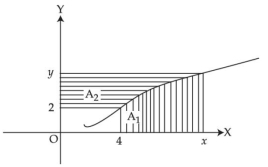
Consider a curve $y=y(x)$ in the first quadrant as shown in the figure. Let the area $A_{1}$ is twice the area $A _{2}$. Then the normal to the curve perpendicular to the line $2 x -12 y =15$ does NOT pass through the point.
If $a=2i+j+2k$  and $b=5i-3j+k,$  then the projection of $b $ on  $ a $ is
The value of $k$ for which the set of equations $x + ky + 3z = 0,$ $3x + ky - 2z = 0,$ $2x + 3y - 4z = 0$ has a non trivial solution over the set of rationals is
If w is a non-real cube root of unity and n is not a multiple of 3, then $\begin{vmatrix}1&\omega^{\text{n}}&\omega^{2\text{n}}\\\omega^{2\text{n}}&1&\omega^{\text{n}}\\\omega^{\text{n}}&\omega^{2\text{n}}&1\end{vmatrix}$ is equal to:
  1. $0$
  2. $\omega$
  3. $\omega^2$
  4. $1$
Consider the system of equations $\mathrm{ax}+\mathrm{by}=0, \mathrm{cx}+\mathrm{dy}=0$, where $\mathrm{a}, \mathrm{b}, \mathrm{c}, \mathrm{d} \in\{0,1\}$.

$STATEMENT -1$ : The probability that the system of equations has a unique solution is $3 / 8$. and $STATEMENT - 2$: The probability that the system of equations has a solution is $1$ .