Question
The mixture a pure liquid and a solution in a long vertical column (i.e, horizontal dimensions < < vertical dimensions) produces diffusion of solute particles and hence a refractive index gradient along the vertical dimension. A ray of light entering the column at right angles to the vertical is deviated from its original path. Find the deviation in travelling a horizontal distance d < < h, the height of the column.
Answer

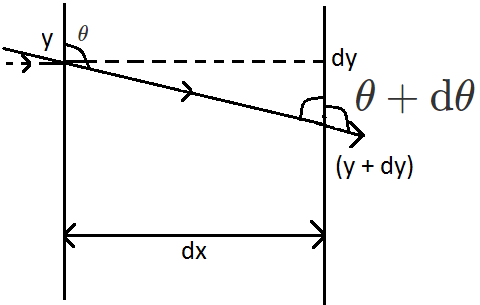
Let us consider a portion of a ray between x and x + dx inside the liquid. Let us suppose the angle of incidence at x be $\theta$ and let it enter the thin column at height y
Because of the bending it shall emerge at x = dx with an angle $\theta+\text{d}\theta$ and at a height y + dy. From Snell's law,

$\mu(\text{y})\sin\theta=\mu(\text{y}+\text{dy})\sin(\theta+\text{d}\theta)$
$\Rightarrow\ \mu(\text{y})\sin\theta=\Big(\mu(\text{y})+\frac{\text{d}\mu}{\text{dy}}\text{dy}\Big)(\sin\theta\cos\text{d}\theta+\cos\theta\sin\text{d}\theta)$
$\big[\because\ \sin(\text{A}+\text{B})=\sin\text{A}\cos\text{B}+\sin\text{B}\cos\text{A}\big]$
Since $\text{d}\theta$ is too small.
Hence, $\cos\text{d}\theta\approx1\text{ and }\text{d}\theta=\text{d}\theta$
$\therefore\ \mu(\text{y})\sin\theta=\Big(\mu(\text{y})+\frac{\text{d}\mu}{\text{dy}}\text{dy}\Big)(\sin\theta+\cos\theta\text{d}\theta)$
$\Rightarrow\ \mu(\text{y})\sin\theta=\mu(\text{y})\sin\theta+\mu(\text{y})\cos\theta\text{d}\theta+\sin\theta\frac{\text{d}\mu}{\text{dy}}\text{dy}+\frac{\text{d}\mu}{\text{dy}}\text{dy}\cos\theta\text{d}\theta$
$\Rightarrow\ \mu(\text{y})\cos\theta\text{d}\theta=-\frac{\text{d}\mu}{\text{dy}}\text{dy}\sin\theta\ \ \bigg[\text{Neglecting}\frac{\text{d}\mu}{\text{dy}}\text{dy}\cos\theta\text{d}\theta\bigg]$
$\Rightarrow\ \text{d}\theta=\frac{-\text{d}\mu}{\mu\text{dy}}\text{dy}\tan\theta$
From the figute, we have $\tan\theta=\frac{\text{dx}}{\text{dy}}$
$\therefore\ \text{d}\theta=\frac{-1\text{d}\mu}{\mu\text{dy}}\text{dx}$
Solving this variable separable from of differential equation, we get
$\therefore\ \theta=\frac{-1\text{d}\mu}{\mu\text{dy}}\int_0^\text{d}\text{dx}=\frac{-1\text{d}\mu}{\mu\text{dy}}\text{d}$

Need a full question paper?

Generate a complete, print-ready paper with questions like this in minutes — across 16+ boards, with answer keys.

Start Generating Free

Similar questions

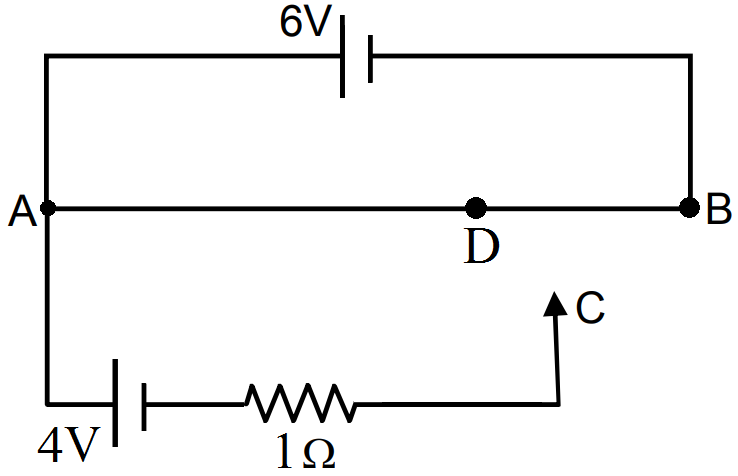
A 6 volt battery of negligible internal resistance is connected across a uniform wire AB of length 100cm. The positive terminal of another battery of emf 4V and internal resistance $1\Omega$ is joined to the point A, as shown in the figure. Take the potential at B to be zero. (a) What are the potentials at the points A and C? (b) At which point D of the wire AB, the potential is equal to the potential at C? (c) If the points C and D are connected by a wire, what will be the current through it? (d) If the 4V battery is replaced by a 7.5V battery, what would be the answers of parts (a) and (b)?

Explain the uses of Polaroid.
Find the current through the $10\Omega$ resistor shown in figure.

A U-shaped wire is placed before a concave mirror having radius of curvature 20cm. Find the total length of the image.

Consider the potentiometer circuit as arranged in the figure. The potentiometer wire is 600cm long. (a) At what distance from the point A should the jockey touch the wire to get zero deflection in the galvanometer? (b) If the jockey touches the wire at a distance of 560cm from A, what will be the current in the galvanometer?

  1. Obtain lens makers formula using the expression

 $\frac{\text{n}_{2}}{\text{v}} - \frac{\text{n}_{1}}{\text{u}} = \frac{(\text{n}_{2} - \text{n}_{1})}{\text{R}}$ 

Here the ray of light propagating from a rare medium of refractive index (n1) to a denser medium of refractive index (n2) is incident on the convex side of spherical refracting surface of radius of curvature R.

  1. Draw a ray diagram to show the image formation by a concave mirror when the object is kept between its focus and the pole. Using this diagram, derive the magnification formula for the image formed.
Standing waves of frequency 5.0kHz are produced in a tube filled with oxygen at 300K. The separation between the consecutive nodes is 3.3cm. Calculate the specific heat capacities Cp and Cof the gas.
A small object is placed at the centre of the bottom of a cylindrical vessel of radius 3cm and height 4cm filled completely with water. Consider the ray leaving the vessel through a corner. Suppose this ray and the ray along the axis of the vessel are used to trace the image. Find the apparent depth of the image and the ratio of real depth to the apparent depth under the assumptions taken. Refractive index of water = 1.33
The property of diamagnetism is said to be present in all materials. Then, why are some materials paramagnetic or ferromagnetic?
Answer the following questions:
  1. Explain qualitatively on the basis of domain picture the irreversibility in the magnetisation curve of a ferromagnet.
  2. The hysteresis loop of a soft iron piece has a much smaller area than that of a carbon steel piece. If the material is to go through repeated cycles of magnetisation, which piece will dissipate greater heat energy?
  3. ‘A system displaying a hysteresis loop such as a ferromagnet, is a device for storing memory?’ Explain the meaning of this statement.
  4. What kind of ferromagnetic material is used for coating magnetic tapes in a cassette player, or for building ‘memory stores’ in a modern computer?
  5. A certain region of space is to be shielded from magnetic fields. Suggest a method.