MCQ
The mixture which shows positive deviation from Raoult's law is 
  • A
    Chloroethane $+$ Bromoethane
  • Ethanol $+$ Acetone
  • C
    Benzene $+$ Toluene
  • D
    Acetone $+$ Chloroform

Answer

Correct option: B.
Ethanol $+$ Acetone
b
Hydrogen bond of ethanol gets weakened by addition of acetone.

Need a full question paper?

Generate a complete, print-ready paper with questions like this in minutes — across 16+ boards, with answer keys.

Start Generating Free

Similar questions

In the Claisen-Schmidt reaction to prepare $351 \mathrm{~g}$ of dibenzalacetone using $87 \mathrm{~g}$ of acetone, the amount of benzaldehyde required is . . . . . . .g. (Nearest integer)
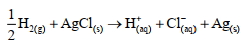
The reaction;

(Image)

occurs in which of the following galvanic cell
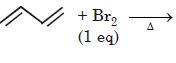
major product is ?
The bond angle in $P{H_3}$ is
A mixture of all isomers possible from the mono-chlorination of  the structure is subjected to fractional distillation, then how many fractions will be obtained?
The molar conductance of $\mathrm{NaCl}, \mathrm{HCl}$ and $\mathrm{CH}_{3} COONa$ at infinite dilution are $126.45,426.16$ and $91.0\, \mathrm{~S} \,\mathrm{~cm}^{2} \,\mathrm{~mol}^{-1}$ respectively. The molar conductance of $\mathrm{CH}_{3} \mathrm{COOH}$ at infinite dilution is. Choose the right option for your answer. (In $\mathrm{~S} \mathrm{~cm}^{2} \mathrm{~mol}^{-1}$)
$K _{ a_1,}, K _{ a_2 }$ and $K _{ a_3}$ are the respective ionization constants for the following reactions $(a), (b),$ and $(c)$.

$(a)$ $H _{2} C _{2} O _{4} \rightleftharpoons H ^{+}+ HC _{2} O _{4}^{-}$

$(b)$ $HC _{2} O _{4}^{-} \rightleftharpoons H ^{+}+ HC _{2} O _{4}^{2-}$

$(c)$ $H _{2} C _{2} O _{4} \rightleftharpoons 2 H ^{+}+ C _{2} O _{4}^{2-}$

The relationship between $K_{a_{1}}, K_{ a _{2}}$ and $K_{ a _{3}}$ is given as

Choose the $CORRECT$ reason for fluorine being a stronger oxidising agent than chlorine 

$(I)$ Low enthalpy of dissociation of $F-F$ bond

$(II)$ High hydration enthalpy of $F^-$

$(III)$ Low atomisation enthalpy of $F_2$

Chlorine can be manufactured from
The solubility product of $AgCl$ is $10^{-10}\, M^2$. The minimum volume (in $m^3$) of water required to dissolve $14.35\, mg$ of $AgCl$ is approximately