MCQ
The molecule has $sp^3d^2$, hybridisation and square planar shape
  • A
    $SF_4$
  • B
    $BF_4^-$
  • $ICl_4^-$
  • D
    $XeO_2F_2$

Answer

Correct option: C.
$ICl_4^-$
c
Chemical species Hybridisation of central atom
$ICl _2^{-}$ $sp ^3 d$
$IF _6^{-}$ $sp ^3 d ^3$
$ICl _4^{-}$ $sp ^3 d ^2$
$BrF _2^{-}$ $sp ^3 d$

Need a full question paper?

Generate a complete, print-ready paper with questions like this in minutes — across 16+ boards, with answer keys.

Start Generating Free

Similar questions

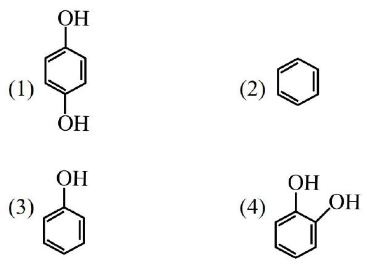
Benzene is treated with oleum to produce compound (X) which when further heated with molten sodium hydroxide followed by acidification produces compound (Y).The compound Y is treated with zinc metal to produce compound $(\mathrm{Z})$. Identify the structure of compound $(\mathrm{Z})$ from the following option.
Image
The ionic radii of $O _{2}- F ^{-}, Na ^{+}$ and $Mg ^{2+}$ are in the order :
Which of the following is the best stereochemical representation when reaction between $1$ -methylcyclohexene and $NBS$ react in aqueous dimethyl sulfoxide  ?
What is $ ‘A’$  in the following reaction $2F{e^{3 + }}_{(aq)} + S{n^{2 + }}_{(aq)} \to 2F{e^{2 + }}_{(aq)} + A$
$(Z )-2$ -Butene reacts with $Br_2/H_2O$. The resulting bromohydrin when  treated with methoxide in methanol undergoes an intramolecular $S_{N^2}$ reaction. Taking into consideration the stereochemical consequences of the  reaction mechanism involved, choose the final product $(s)$ of these  transformations.
In reaction of alcohols with alkali metal, acid etc. which of the following alcohol will react fastest
Which shows polymorphism
Choose the correct order for given property
$(M.P. \to  Melting Point ;    S \to Solubility)$
The d-orbital electronic configuration of the complex among $\left[\mathrm{Co}(\mathrm{en})_{3}\right]^{3+}, \left[\mathrm{CoF}_{6}\right]^{3-}$, $\left[\mathrm{Mn}\left(\mathrm{H}_{2} \mathrm{O}\right)_{6}\right]^{2+}$ and $\left[\mathrm{Zn}\left(\mathrm{H}_{2} \mathrm{O}\right)_{6}\right]^{2+}$ that has the highest CFSE is :
Amongest following the lowest degree of paramagnetism per mole of the compound at $298 K$  will be shown by